
LED bulbs can sometimes remain faintly illuminated after the wall switch is turned off because a very small amount of electrical current is still passing through the lighting circuit.
LEDs require much less power to produce visible light than traditional incandescent bulbs. As a result, tiny amounts of current that would have had no visible effect on an incandescent lamp may be enough to make an LED glow, pulse, or occasionally flash.
Lighting-control manufacturers often call this effect LED ghosting. Lutron describes ghosting as LEDs remaining faintly illuminated while the dimmer or switch is in the off position and notes that low-wattage LED loads can be particularly sensitive to small leakage currents. Leviton likewise identifies leakage current as a common cause of LEDs glowing faintly after shutoff.
A faint, stable glow caused by switch and bulb compatibility may be more annoying than dangerous. But persistent glowing combined with flickering, buzzing, heat, unusual odors, or other electrical symptoms deserves professional evaluation.
Why Do LED Bulbs Glow After the Switch Is Turned Off?
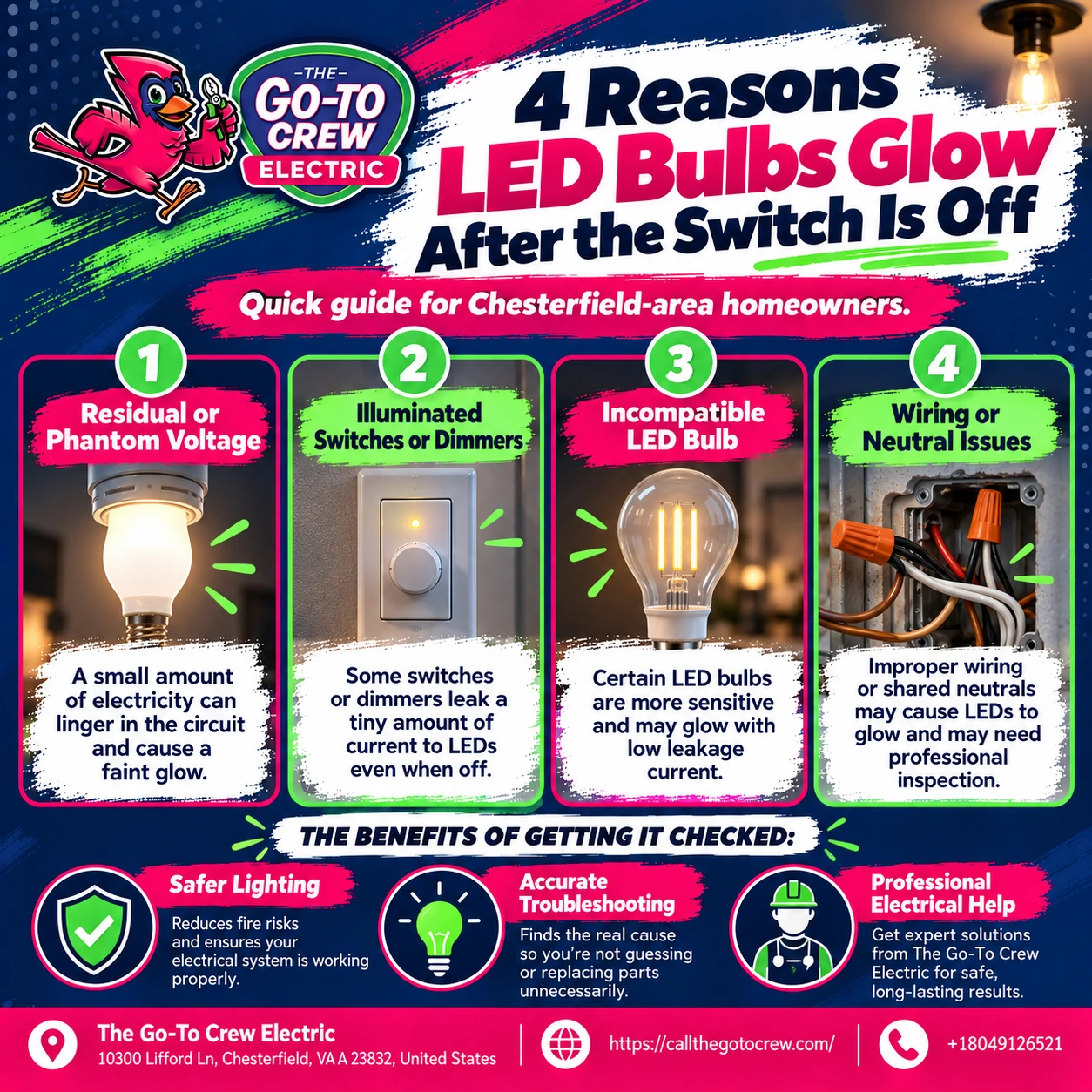
In many cases, the switch is technically “off,” but a tiny amount of current still passes through the circuit.
That current may be associated with:
- An electronic dimmer
- A smart switch
- An illuminated switch
- A locator light inside the switch
- LED bulb sensitivity
- Dimmer and bulb incompatibility
- Certain wiring configurations
- A wiring problem or unintended current path
Traditional incandescent bulbs needed considerably more current before their filaments produced visible light.
LED electronics are different.
Even a very small current can sometimes partially charge the LED driver’s internal electronics. The bulb may then:
- Glow continuously at a very low level
- Pulse faintly
- Flash every few seconds
- Appear to shimmer in a dark room
Lutron notes that in some electronic controls, a small current continues through the lighting load so that the control itself can remain powered. Some LEDs ignore that current, while more sensitive lamps may visibly glow.
Can Small Amounts of Current Keep an LED Glowing?
Yes.
This is one of the main reasons LED afterglow occurs.
An LED can produce visible light using very little electrical energy. If a tiny amount of current continues flowing through the lamp after the switch has been turned off, its electronic driver may still receive enough energy to produce a faint glow.
Lutron explains that small leakage currents can cause LEDs to remain faintly illuminated and can sometimes slowly charge the lamp’s internal power supply until it briefly flashes.
This can explain several different symptoms:
Constant faint glow:
The LED receives enough current to remain barely illuminated.
Periodic flashing:
The lamp electronics slowly accumulate energy, briefly turn on, discharge, and begin charging again.
Occasional flickering:
The small current and lamp electronics interact inconsistently.
The behavior may only be visible at night because the amount of light produced is very small.
Can Dimmer Switches Cause LED Ghosting?
Yes. Dimmer compatibility is one of the most common causes of LED ghosting.
Some dimmers, especially electronic models that do not use a neutral connection, need a small amount of current for their internal electronics.
Depending on the design, that current may pass through the lighting load even when the dimmer appears to be off.
Lutron specifically identifies certain non-neutral dimmers and digital switches as more prone to ghosting with low-wattage LED loads. It also emphasizes that compatibility between the LED lamp and the dimmer is important because different LED products respond differently to very small currents.
Problems may be more noticeable when:
- Only one LED bulb is connected to the dimmer
- The total lighting load is very low
- An older dimmer was designed primarily for incandescent bulbs
- The LED is not listed as compatible with the dimmer
- The dimmer contains electronic features that remain energized
A bulb being labeled “dimmable” does not guarantee perfect operation with every dimmer.
If afterglow begins after changing from incandescent bulbs to LEDs, the bulb-switch combination is worth investigating.
Are Some LED Bulbs More Sensitive Than Others?
Yes.
LED lamps contain electronic drivers, and different manufacturers and models use different designs.
One LED bulb may completely ignore a tiny leakage current while another connected to the same control may glow faintly.
Lutron notes that LED performance can vary significantly from bulb to bulb and that even lamps marketed as dimmable do not necessarily behave identically with every control.
Sensitivity may vary because of differences in:
- Internal driver electronics
- Minimum operating current
- Dimming technology
- Lamp wattage
- Driver filtering
- Fixture design
That is why changing the bulb can sometimes change or eliminate ghosting even though no other part of the circuit has changed.
This does not automatically mean either the bulb or switch is defective.
It may simply be a compatibility issue.
Can Illuminated or Smart Switches Cause a Faint Glow?
Yes.
Illuminated switches and smart controls can cause LED afterglow because some of these devices need a small electrical current even while the controlled light is turned off.
Illuminated switches
Some wall switches contain a small locator or indicator light so homeowners can find the switch in the dark.
Leviton explains that current used by certain locator lights can pass through the LED load and cause a sensitive bulb to glow.
Leviton also notes that traditional illuminated-switch designs can produce LED ghosting because of leakage current.
Smart switches and dimmers
Smart controls may need continuous power so their electronics can:
- Receive wireless commands
- Maintain network connections
- Respond to app controls
- Operate internal status indicators
Certain smart dimmers without a neutral connection obtain that power by allowing a very small current through the connected lighting load.
Lutron notes that this small current can be enough to make especially sensitive LEDs glow or flicker.
Some newer smart controls are specifically designed to reduce this effect. For example, Leviton markets certain neutral-connected smart dimmers with technology intended to keep low-wattage LED loads completely off.
Can Wiring Issues Cause LEDs to Stay Dimly Lit?
They can.
LED ghosting is often a compatibility issue, but it should not automatically be assumed harmless when other electrical symptoms are present.
Potential wiring-related conditions may include:
- Loose electrical connections
- Improper switch wiring
- Problems involving the neutral conductor
- Damaged wiring
- Incorrectly modified multi-way switching
- Problems introduced during previous electrical work
Loose connections can also contribute to flickering or unstable light output.
Philips Hue identifies loose fixture or wiring connections and irregular electrical supply as possible causes of LED flickering and recommends professional evaluation when wiring or supply issues are suspected.
Wiring becomes more concerning when LED afterglow occurs together with:
- Buzzing
- Crackling
- Burning smells
- Warm switches
- Discoloration
- Sparks
- Repeated breaker trips
- Lights changing brightness unpredictably
Do not remove the switch or open electrical boxes simply to investigate why an LED glows.
A licensed electrician can determine whether the condition is normal control behavior or evidence of a wiring problem.
What Safe Checks Can Homeowners Make?
Homeowner troubleshooting should remain simple and non-invasive.
You can safely observe:
- Whether one bulb or several bulbs glow
- Whether the light is controlled by a dimmer
- Whether the switch has an illuminated locator
- Whether it is a smart switch
- Whether the issue began after changing bulbs
- Whether the bulbs are labeled dimmable
- Whether the bulb manufacturer lists the control as compatible
- Whether there is flickering, buzzing, or another symptom
If the problem began immediately after installing new LED bulbs, checking the bulb manufacturer’s and dimmer manufacturer’s compatibility information can be helpful.
Lutron provides compatibility information specifically because different LED and dimmer combinations can produce ghosting, flicker, minimum-load problems, and other performance differences.
Avoid:
- Opening the switch box
- Rewiring the switch
- Installing capacitors or other electrical components unless specifically handled by a qualified person
- Modifying neutral conductors
- Bypassing smart-switch features
- Working on energized wiring
If a switch or wiring change appears necessary, have the circuit evaluated professionally.
When Is LED Afterglow Harmless?
A faint glow may be primarily a compatibility issue when:
- The LED is only barely visible in darkness
- It occurs consistently with a particular dimmer or electronic switch
- There is no buzzing
- The switch and fixture remain cool
- There is no burning odor
- There are no breaker trips
- The lights otherwise operate normally
Lutron specifically states that certain ghosting caused by small leakage currents does not damage the LED lamps or compatible dimmer involved.
That does not mean every glowing LED should automatically be dismissed.
If the condition is new, getting worse, affects multiple circuits, or is accompanied by other electrical symptoms, professional inspection is more appropriate.
Persistent afterglow can also be worth correcting simply because it is distracting in bedrooms, hallways, or other dark spaces.
When Should the Switch or Wiring Be Inspected?
Professional inspection makes sense when:
- The LED glow appeared suddenly after years of normal operation
- Several unrelated fixtures are behaving abnormally
- The light flickers aggressively while switched off
- A switch buzzes or crackles
- The wall plate feels unusually warm
- You smell burning or overheated insulation
- You see discoloration
- The breaker trips
- Recent switch or wiring work was performed
- The LED stays brighter than a faint ghost glow
- Changing to a compatible bulb does not resolve the problem
The electrician may need to determine whether the issue comes from:
- The LED lamp
- Dimmer compatibility
- Smart-switch design
- Locator-light current
- Wiring configuration
- A loose connection
- A circuit fault
The Go-To Crew Electric’s indoor-lighting services include LED lighting, dimming controls, smart-lighting systems, installation, maintenance, and troubleshooting.
Learn more about our indoor lighting services.
How Can an Electrician Diagnose the Problem?
An electrician can narrow down LED afterglow without assuming every faint glow has the same cause.
The evaluation may include:
- Identifying the bulb or fixture type
- Checking whether the lamp and dimmer are compatible
- Identifying the switch or dimmer design
- Determining whether the control requires a neutral
- Checking the wiring configuration
- Inspecting connections
- Evaluating multi-location switches
- Checking for abnormal voltage or electrical behavior
- Determining whether another lighting control would be more appropriate
The solution depends on the cause.
For example, a compatibility problem may call for a different LED lamp or control.
A smart-switch design issue may call for a control that handles low-wattage LED loads differently.
A wiring fault requires correction of the actual electrical problem rather than simply changing the bulb.
The Go-To Crew Electric’s switch guide emphasizes matching switches to the lighting load and wiring system, while its Chester service page lists both indoor lighting and broader electrical troubleshooting services for local homeowners.
Learn more about electrical switch installations or visit our Chester electrician page for local electrical service.
FAQs
Why does my LED bulb glow faintly even though the switch is off?
A tiny amount of current may still be passing through the circuit.
LEDs use so little power that this current can sometimes produce visible light even though an incandescent bulb would appear completely off. This is commonly called LED ghosting.
Does an LED glowing when off mean there is dangerous electricity in the fixture?
Not necessarily.
A faint glow can result from normal leakage current associated with certain electronic dimmers or switches. However, persistent afterglow with buzzing, heat, burning smells, breaker trips, or other abnormal symptoms should be professionally inspected.
Can an old dimmer cause LED lights to glow?
Yes.
Dimmer and LED compatibility matters. Older or incompatible dimmers may not work well with low-wattage LED loads and can contribute to ghosting, flickering, poor dimming range, or other unwanted behavior.
Why does my LED light flash every few seconds when it is switched off?
A tiny leakage current can slowly charge the LED driver’s internal electronics.
Once enough energy accumulates, the lamp may briefly flash, discharge, and repeat the cycle. Lutron documents this behavior with certain LED and control combinations.
Can a smart switch cause an LED bulb to stay faintly lit?
Yes.
Certain smart switches need a small amount of continuous power for their electronics. In some non-neutral configurations, that current passes through the LED load and can cause sensitive bulbs to glow.
Should I call an electrician for LED ghosting?
A faint glow associated with a known dimmer-and-bulb compatibility issue may not require urgent service.
Call an electrician if the cause is unclear, the problem persists after changing compatible bulbs, or the light is also flickering, buzzing, overheating, tripping breakers, or showing other signs of an electrical problem.