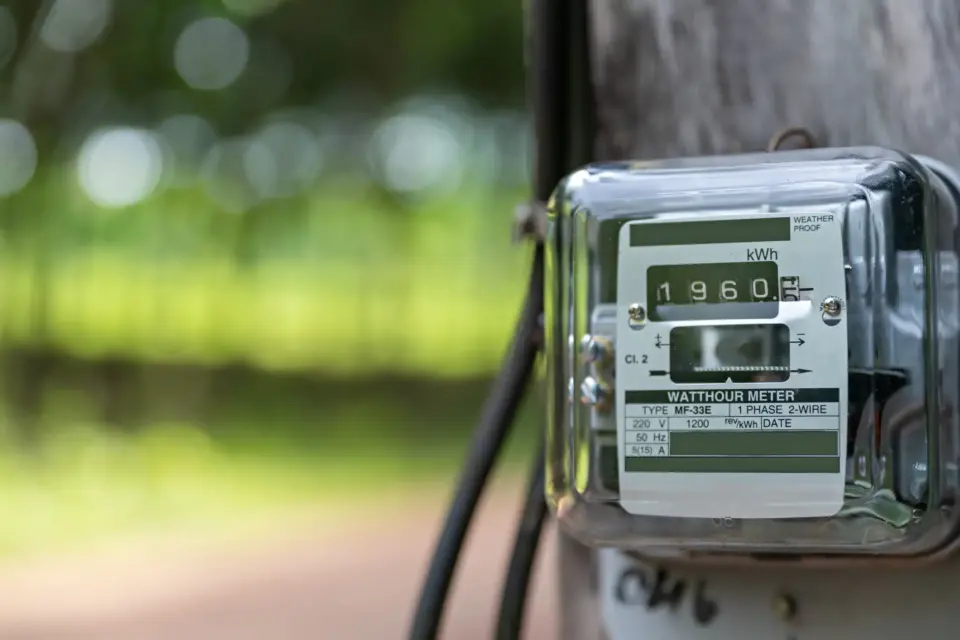
Your electrical panel’s amp rating is only the starting point for determining whether your home has enough electrical capacity.
A home may have a 100-amp, 150-amp, or 200-amp service, but the number on the panel does not by itself tell you how much additional electrical load can safely be added. The answer depends on the home’s existing loads, major appliances, heating and cooling equipment, planned additions, and a code-based electrical load calculation.
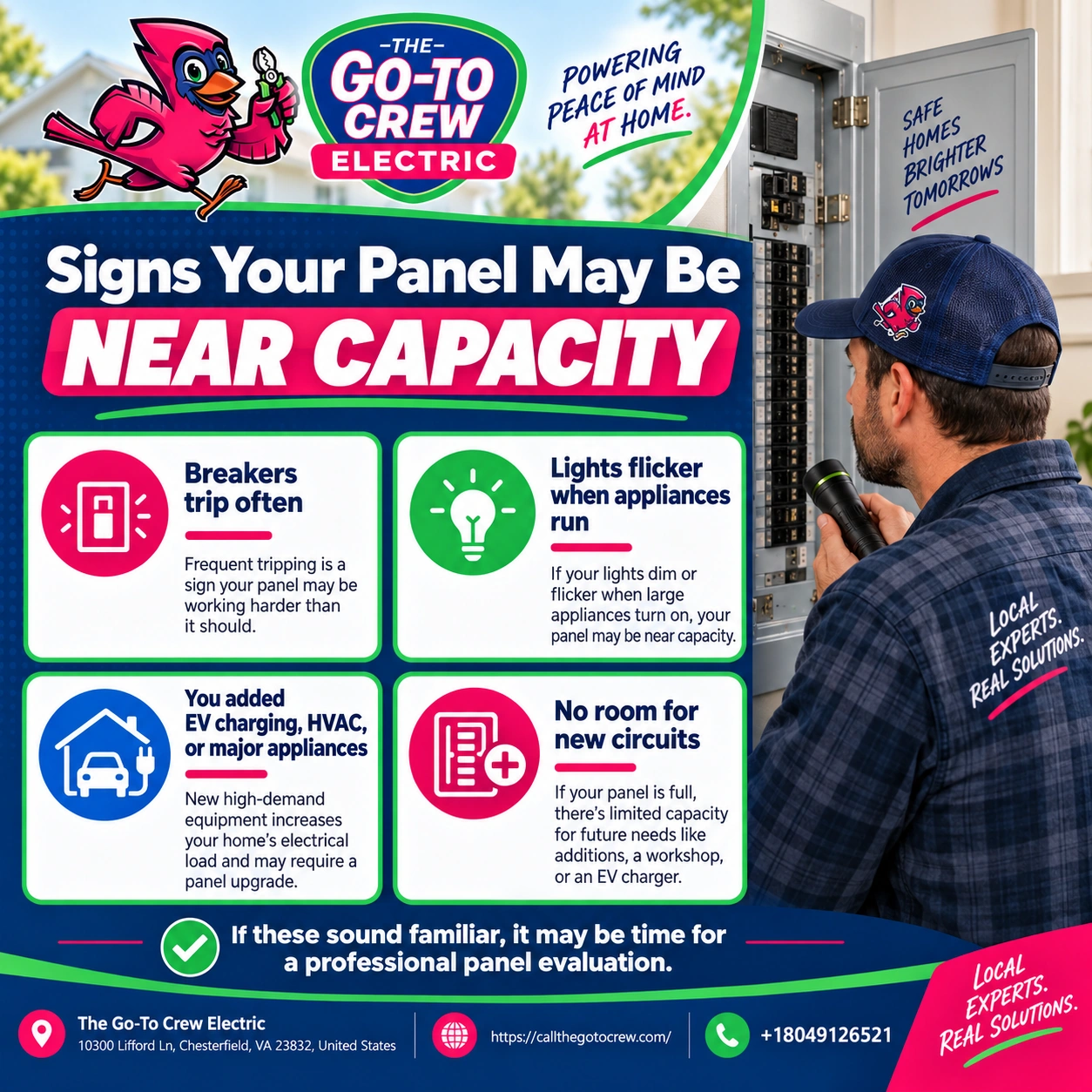
Warning signs such as frequent breaker trips, dimming lights, or an electrical system that struggles when large appliances operate deserve professional evaluation. However, those symptoms can also come from an overloaded individual circuit or another electrical problem rather than an undersized service. ESFI recommends professional inspection when breakers frequently trip or other overload warning signs occur.
If you are considering an EV charger, electric range, heat pump, hot tub, workshop equipment, addition, or another significant electrical load, having an electrician evaluate available capacity before installation can prevent guesswork.
What Does Electrical Panel Capacity Mean?
Electrical panel capacity generally refers to how much electrical current the home’s service and distribution equipment are designed to handle safely.
Your main electrical panel receives power from the electrical service and distributes that power to individual circuits throughout the house. Circuit breakers protect those circuits by interrupting current when an unsafe overcurrent condition occurs.
For homeowners, there are several related but different ideas to understand:
- Service amperage: The overall electrical service available to the home.
- Panel rating: The maximum rating of the panel equipment itself.
- Main breaker rating: The amperage at which the main overcurrent device is designed to operate.
- Branch circuit ratings: The ratings of individual breakers supplying lights, outlets, appliances, and equipment.
- Available capacity: How much additional calculated load the existing service can accommodate.
These numbers are related, but they are not interchangeable.
For example, having empty breaker spaces does not necessarily mean you have enough electrical capacity for a major new appliance. Likewise, a panel that looks full may sometimes have enough service capacity but simply need a different distribution solution.
That distinction is why a load evaluation is more useful than simply counting breakers.
How Can You Identify Your Panel’s Amp Rating?
One clue is the rating printed on the main breaker.
Common residential main breaker markings may include values such as:
- 100 amps
- 125 amps
- 150 amps
- 200 amps
Panel equipment also has manufacturer labels and ratings.
Homeowners can safely look at visible labels and breaker markings without removing the panel’s protective cover. Do not remove the dead front, touch internal conductors, or attempt measurements inside an energized electrical panel.
The main breaker rating is useful information, but it should not always be treated as the final answer to your home’s service capacity.
A professional evaluation may also consider:
- The service entrance conductors
- Meter and service equipment
- Panel bus rating
- Main disconnect
- Existing configuration
- Applicable electrical code
- Utility service
An electrician can confirm whether the visible breaker rating accurately represents the capacity of the complete service.
How Much Electrical Capacity Does a Typical Home Need?
There is no single amp rating that every home needs.
ESFI notes that modern homes commonly use electrical services in the 100- to 200-amp range, while older homes may have smaller legacy services.
But a home’s actual requirement depends far more on its electrical loads than on square footage alone.
Two similarly sized homes can have very different electrical demands.
One might use:
- Gas heat
- Gas water heating
- Gas cooking
- No EV charger
Another may have:
- Electric heat pumps
- Electric water heating
- Electric cooking
- Electric clothes drying
- An EV charger
- A hot tub
- Workshop equipment
The second home can place substantially greater demand on its electrical service.
That is why saying every modern home “needs 200 amps” is too simplistic. A qualified electrician uses a load calculation to determine whether the existing service is sufficient for the home’s actual and proposed equipment.
What Are the Signs Your Electrical Demand Is Too High?
Several symptoms can justify having your electrical system evaluated.
ESFI lists warning signs of overloaded electrical systems including:
- Frequently tripped breakers or blown fuses
- Lights that dim when other equipment turns on
- Buzzing from switches or outlets
- Discolored receptacles
- Appliances that appear underpowered
Other reasons to request a capacity review include:
- You are adding several major electrical appliances
- You want to install an EV charger
- You are converting gas appliances to electric
- You are adding a heat pump or electric HVAC equipment
- You are installing a hot tub or pool equipment
- You are building an addition
- You are adding a large workshop
- Your panel has no practical room for new circuits
These signs do not automatically prove the entire electrical service is undersized.
For example, a breaker that repeatedly trips may indicate an overloaded branch circuit, short circuit, fault, wiring issue, or equipment problem. ESFI specifically recommends having repeated breaker trips evaluated by a qualified electrician.
A professional diagnosis can determine whether the problem is one circuit or the capacity of the electrical service as a whole.
What Is an Electrical Load Calculation?
An electrical load calculation is a structured method for determining how much electrical demand a home is expected to place on its service.
It is not simply a count of appliances.
Residential load calculations consider categories such as:
- General lighting and receptacle loads
- Kitchen and laundry circuits
- Permanently connected appliances
- Electric ranges and ovens
- Clothes dryers
- Water heaters
- Heating and air-conditioning equipment
- Other major electrical loads
The National Electrical Code includes methods for calculating dwelling-unit feeder and service loads rather than assuming every connected device will draw its full rated current at exactly the same time.
This calculation becomes especially useful when deciding whether an existing service can handle a new load.
An electrician may perform one before installing equipment such as:
- EV charging
- A larger HVAC system
- Electric water heating
- Additional kitchen appliances
- A hot tub
- An addition
- Major workshop equipment
The result helps determine whether the existing system has adequate capacity or whether another solution should be considered.
Why Breaker Sizes Alone Do Not Show Total Available Capacity
A common mistake is to add up every breaker number in the panel and compare the total with the main breaker.
For example, a homeowner might see ten 20-amp breakers, several 30-amp breakers, and a 50-amp breaker and wonder why their total is much higher than a 200-amp main breaker.
That is normal.
Branch breaker ratings indicate the maximum current permitted on individual circuits. They do not represent the amount of electricity all those circuits are expected to use simultaneously.
Residential electrical design uses calculated demand rather than simply adding every branch breaker’s rating together. NFPA’s dwelling load-calculation provisions apply specific methods and demand factors to general loads, appliances, heating, cooling, and other equipment.
That means neither of these methods reliably determines spare capacity:
- Adding all breaker ratings together
- Counting unused breaker spaces
The correct question is how the home’s calculated load compares with the capacity of the existing electrical service.
How New Appliances Can Affect Panel Capacity
Modern electrification can change a home’s electrical demand quickly.
One major new load may matter more than several smaller household devices.
Examples include:
EV chargers
Level 2 EV charging can represent a significant electrical load. Current NEC provisions specifically account for EV supply equipment when service and feeder capacity are evaluated.
Electric ranges and ovens
Replacing gas cooking equipment with electric appliances can add a substantial new load.
Heat pumps and electric HVAC
Heating and cooling equipment is specifically considered in residential load calculations.
Electric water heaters
Traditional electric water heaters and some high-demand electric water-heating systems can materially affect the load calculation.
Hot tubs and pool equipment
Pumps, heaters, and related equipment can require new dedicated circuits.
Workshops
Welders, compressors, woodworking equipment, and other shop tools may require substantial electrical capacity depending on how they are used.
Before purchasing major electrical equipment, it can be useful to know whether the existing service can support it.
The Go-To Crew Electric’s residential service page notes that its electricians assess current and future power requirements when recommending electrical panel solutions.
When Might a Panel Upgrade Be Recommended?
A panel or service upgrade may be considered when the existing system cannot safely or practically support the home’s present or planned electrical demand.
Possible situations include:
- A load calculation shows inadequate service capacity
- Major electrification projects are planned
- The existing panel is outdated or unsuitable for planned circuits
- The electrical equipment has condition or safety problems
- A renovation or addition significantly increases demand
- Existing equipment needs replacement and greater capacity is appropriate
A panel upgrade should not be recommended solely because a panel is old or because a homeowner wants one additional circuit.
The electrician should evaluate what limitation actually exists.
That might involve the service capacity, panel condition, circuit space, service conductors, utility requirements, or a combination of factors.
The Go-To Crew Electric provides panel installation, repair, maintenance, and upgrade services and states that its team evaluates system requirements when recommending panel solutions.
For more information, visit the electrical panel service page.
When Does a Subpanel Make More Sense?
A subpanel can be useful when the home’s existing electrical service has sufficient capacity but additional circuit space or more convenient distribution is needed.
Common examples include:
- A home addition
- Detached garage
- Workshop
- Finished basement
- Pool equipment area
- A group of new circuits located far from the main panel
Eaton describes a subpanel as equipment installed downstream from the main service entrance panel and supplied from that existing electrical system.
This leads to an important point:
A subpanel does not, by itself, increase the total electrical service capacity coming into the home.
It can provide additional breaker spaces and distribute existing available capacity to another area, but the main service still has to be capable of supplying the added loads.
So there are really two different problems:
- Enough service capacity, but not enough practical circuit space: a subpanel may be appropriate.
- Not enough overall service capacity: adding a subpanel alone does not solve the capacity problem.
A load evaluation helps distinguish between the two.
Why a Professional Load Evaluation Matters
Electrical capacity is difficult to judge accurately from appearance alone.
A professional evaluation can consider:
- Main service rating
- Panel and equipment ratings
- Existing major loads
- Heating and cooling equipment
- Proposed appliances
- EV charging
- Available breaker space
- Condition of the panel
- Applicable electrical-code requirements
- Whether a subpanel or service upgrade is appropriate
It also avoids unsafe DIY investigation.
Homeowners should not remove panel covers, probe energized equipment, change breaker sizes, or attempt to measure service conductors to determine capacity.
ESFI recommends qualified electrical inspection when a home has repeated breaker trips, major renovations, additions, or significant new appliances.
For homeowners in Midlothian, The Go-To Crew Electric provides residential electrical services including inspections, circuit-breaker work, electrical panel service, EV charging, and other system upgrades.
Learn more about residential electrical services or visit our Midlothian electrician page for local service information.
FAQs
Does a 200-amp panel mean I have 200 amps available for new appliances?
No.
A 200-amp service represents the rating of the service equipment, but your home is already using some of that capacity. The amount available for additional equipment depends on the home’s calculated existing and proposed load.
A load calculation can determine whether there is sufficient capacity for the new equipment.
How can I tell whether I have 100-amp or 200-amp service?
The number printed on the main breaker can provide a useful clue. You may also see manufacturer ratings on accessible panel labels.
Do not remove the panel’s protective cover to investigate. An electrician can verify the complete service rating if there is any uncertainty.
Does an empty breaker space mean my panel has extra capacity?
Not necessarily.
An empty space means there may be physical room for another compatible breaker. It does not prove that the electrical service has enough unused capacity for the load you want to add.
Both breaker space and service capacity need to be considered.
Why do all my breaker ratings add up to more than my main breaker?
That is normal in residential electrical systems.
Individual breaker ratings protect individual circuits, and all circuits are not assumed to operate at their maximum rating simultaneously. Electrical load calculations use code-defined methods to estimate expected service demand rather than simply adding breaker handles together.
Do I need a panel upgrade before installing an EV charger?
Not automatically.
Whether an existing service can support EV charging depends on the charger’s load and the home’s existing electrical demand. A load calculation should be performed before assuming that a service upgrade is necessary.
Current NEC provisions specifically account for EV charging loads in service and feeder sizing.
Will installing a subpanel give my house more electrical capacity?
No. A subpanel is supplied from the existing electrical service, so it does not independently increase the amount of utility power available to the home.
A subpanel can provide additional circuit spaces or make distribution more convenient when the existing service already has adequate capacity.