You install a smart thermostat expecting easier temperature control, convenient scheduling, and the ability to adjust your home’s heating or cooling from your phone.
But instead, the thermostat keeps restarting, the screen goes blank, or your heating and cooling system stops responding the way it should.
That can leave you wondering whether the new thermostat is causing an electrical problem.
Yes, a smart thermostat can contribute to electrical or HVAC control problems when its wiring, power requirements, or system compatibility aren’t correct. However, a blank screen or malfunctioning heating system doesn’t automatically mean the thermostat is defective. The cause may involve the thermostat’s low-voltage power supply, HVAC transformer, control wiring, or another system component.
At The Go-To Crew Electric, we help Richmond, VA, homeowners evaluate electrical concerns and determine when wiring or power-supply problems need professional attention.
Here’s what you should know about smart thermostat electrical problems, how to recognize common symptoms, and when an electrician or HVAC technician may be needed.
Quick Answer: Can a Smart Thermostat Cause Electrical Problems?
A smart thermostat relies on an appropriate electrical supply to operate its display, communication features, and heating or cooling controls.
When the thermostat isn’t compatible with the existing system or isn’t receiving reliable power, several problems can occur.
You may notice:
- A thermostat screen that turns off unexpectedly
- Frequent restarting or low-battery warnings
- Wi-Fi connections that repeatedly disconnect
- Heating or cooling equipment that doesn’t respond
- A fan or HVAC system that runs unexpectedly
- An error message related to the thermostat’s power supply
Some of these symptoms are caused by thermostat configuration or compatibility issues.
Others may involve the HVAC system’s electrical components or the home’s power supply.
The important distinction is that most conventional smart thermostats use an HVAC system’s low-voltage control circuit rather than connecting directly to the home’s standard household power supply.
An electrician may need to investigate problems with the electrical supply or fixed wiring, while an HVAC technician is often the right professional for thermostat compatibility and equipment controls.
How Smart Thermostats Receive Power
To understand why electrical problems happen, it helps to know how a smart thermostat receives electricity.
Many conventional residential HVAC systems use a transformer to supply low-voltage power for their thermostats and controls.
In common North American systems, this control voltage is typically around 24 volts AC.
However, not every heating and cooling system uses that arrangement.
Traditional Thermostats and Smart Thermostats
Older thermostats may use relatively little electricity.
Some rely on mechanical controls or batteries, while others draw power from the HVAC control circuit.
Smart thermostats often require additional power for features such as:
- Digital displays
- Wi-Fi communication
- Remote access
- Scheduling and automation
- Sensors and software functions
That additional demand can make power compatibility more important.
A system that operated successfully with an older thermostat may not provide power in the same way a particular smart thermostat requires.
The HVAC Transformer
In a conventional low-voltage HVAC setup, a transformer reduces the equipment’s incoming electrical supply to the voltage used by the thermostat and control system.
The transformer may be located within the furnace, air handler, or other HVAC equipment.
The thermostat then uses the control wiring to receive power and communicate heating or cooling requests.
If the transformer or another part of the control circuit develops a problem, the thermostat may lose power or behave unpredictably.
Not Every Thermostat System Is Low Voltage
Some heating systems use line-voltage thermostats.
Others use proprietary communication systems or specialized control arrangements.
A smart thermostat designed for a conventional low-voltage HVAC system may not work with those installations.
That’s why checking compatibility before installation is essential.
Never assume that similar-looking thermostat wires mean two devices are interchangeable.
What Are the Most Common Compatibility Problems?
Smart thermostat compatibility involves more than matching wire colors.
The thermostat must be designed to work with the type of heating and cooling equipment installed in the home.
Unsupported HVAC Systems
Some smart thermostats are designed primarily for conventional low-voltage systems.
They may not support certain line-voltage heating systems, proprietary communicating controls, or specialized equipment.
Other models may support heat pumps, multistage heating, auxiliary heat, or other configurations only when specific requirements are met.
Manufacturer compatibility tools help identify whether the selected thermostat is appropriate.
Incorrect System Configuration
A thermostat may be physically connected but configured for the wrong equipment type.
For example, the settings may not match the home’s heating stages, cooling equipment, or heat pump arrangement.
This can cause incorrect operation even when the device receives power.
An HVAC technician can determine whether the thermostat’s configuration matches the actual system.
Power Requirements That Don’t Match the Existing Wiring
Some smart thermostats need a continuous low-voltage power supply.
Others can operate without a dedicated common wire under certain conditions.
However, an arrangement that works for one thermostat model may not work for another.
Google Nest and ecobee both provide model-specific compatibility and power guidance.
This is why it’s important to check the exact thermostat model rather than rely on general installation advice.
More Than One Transformer
Some HVAC systems use separate transformers for heating and cooling.
Those arrangements can create additional compatibility considerations.
A thermostat or power accessory that works with a single-transformer system may not be appropriate for a dual-transformer setup.
These systems require careful identification before wiring changes are made.
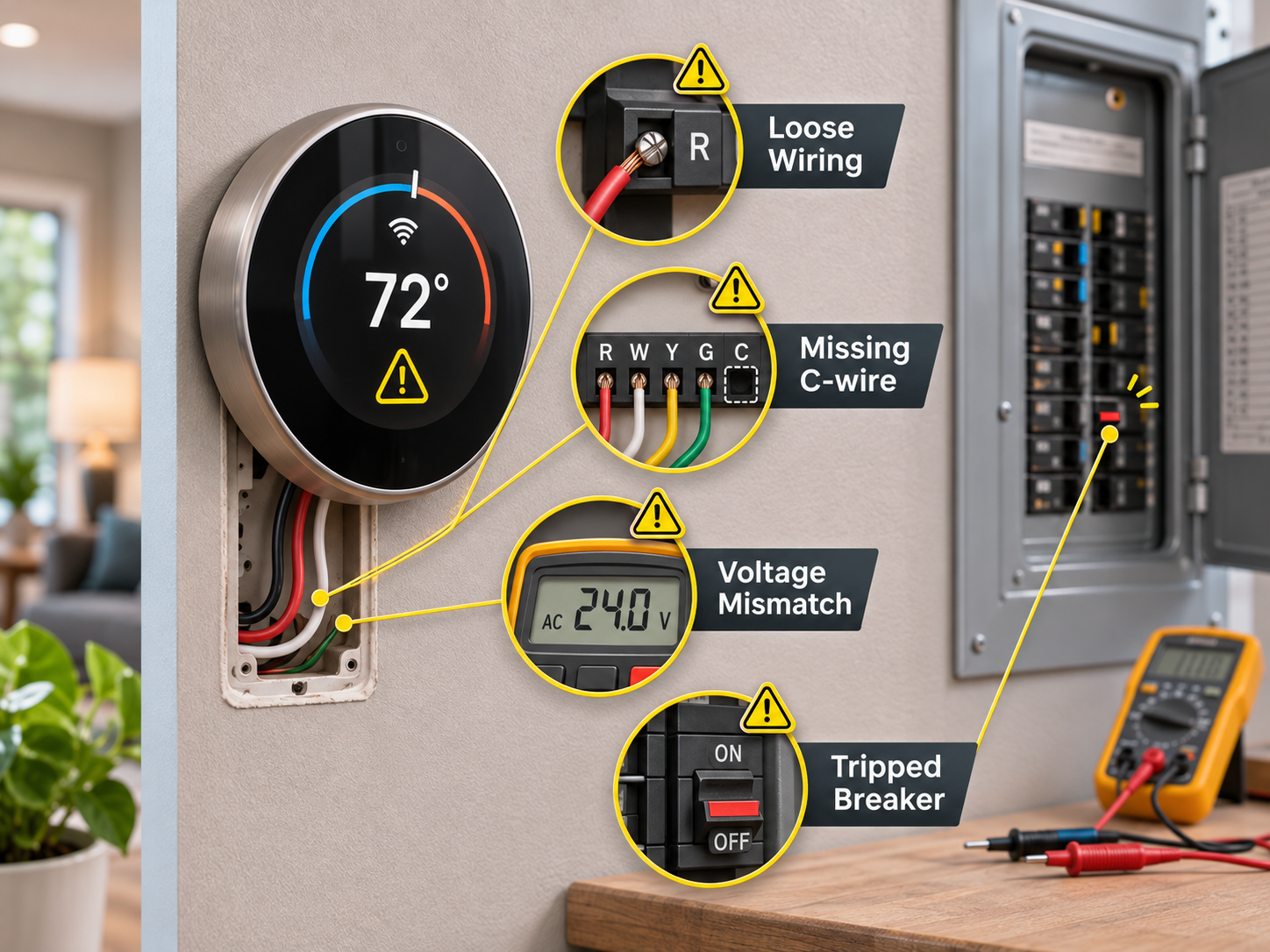
Why the C-Wire Matters for Smart Thermostats
The C-wire, or common wire, is one of the most frequently discussed parts of smart thermostat installation.
It plays an important role in providing a reliable electrical supply to many thermostat models.
What Does the C-Wire Do?
In a conventional low-voltage HVAC system, the C-wire provides the common side of the transformer circuit.
Together with the appropriate power connection, it allows compatible thermostats to receive continuous electrical power.
Unlike control connections that call for heating, cooling, or fan operation, the C-wire primarily serves a power-supply function.
This can help support features that require electricity even when the HVAC equipment isn’t actively heating or cooling.
Does Every Smart Thermostat Need a C-Wire?
No.
Some thermostat models can operate without a traditional C-wire in compatible systems.
Others require one or need an approved power accessory.
For example, Google explains that certain Nest thermostats may operate without a C-wire but can require one or a compatible power connector when the existing system doesn’t supply consistent power.
ecobee also offers an approved Power Extender Kit for certain compatible installations.
These accessories aren’t universally interchangeable.
The correct solution depends on the thermostat model and HVAC system.
Symptoms of Inadequate Power
A thermostat experiencing power-related problems may display:
- Low-battery notifications
- Frequent restarts
- A blank or intermittently working screen
- Repeated Wi-Fi disconnections
- Manufacturer-specific power error messages
- Features that stop working because of insufficient power
However, these symptoms don’t prove that a missing C-wire is responsible.
A transformer issue, wiring fault, control-board problem, or other condition may produce similar symptoms.
Why You Shouldn’t Guess at the Wiring
Thermostat wire colors aren’t a dependable substitute for identifying terminal functions.
An unused wire also doesn’t automatically provide a working common connection.
Connecting the wrong wires can damage equipment.
If the thermostat needs an additional power connection, have a qualified professional determine the appropriate arrangement.
Can a Transformer Problem Affect the Thermostat?
Yes.
The transformer supplies the low-voltage power used by many conventional HVAC controls.
If it fails or cannot provide the required power under operating conditions, the thermostat may stop working correctly.
What Happens When the Transformer Fails?
Depending on the failure, the thermostat may lose power completely or experience intermittent operation.
The HVAC equipment may also stop responding because its control system isn’t receiving the expected electrical supply.
A blank thermostat screen could therefore indicate a problem beyond the thermostat itself.
Can a Transformer Be Overloaded?
A transformer has a limited electrical capacity.
If the connected control equipment demands more power than the transformer can appropriately supply, problems may develop.
The issue could involve additional accessories, incompatible equipment, or a fault within the control circuit.
However, homeowners shouldn’t assume that a transformer needs replacement simply because they installed a smart thermostat.
A professional must evaluate the actual power requirements and the condition of the system.
What About a Blown HVAC Control Fuse?
Some HVAC control boards have protective fuses.
Incorrect wiring or an electrical fault may cause a fuse to open.
When that happens, the thermostat may lose power.
Replacing a fuse without identifying the underlying problem may lead to another failure or leave an unsafe condition unresolved.
This is generally a job for an HVAC professional familiar with the equipment’s control system.
What Symptoms Suggest an Electrical Issue?
Smart thermostat problems can be confusing because many symptoms have more than one possible cause.
The best approach is to note what happens without assuming the thermostat itself is responsible.
Common Symptoms and Possible Causes
| Symptom | Possible explanation | Appropriate next step |
| Thermostat screen stays blank | Lost low-voltage power, control issue, or failed thermostat | Professional evaluation if basic settings don’t explain it |
| Thermostat restarts repeatedly | Inadequate power, device fault, or control-system problem | Check manufacturer messages; contact a qualified professional |
| Wi-Fi repeatedly disconnects | Network issue or inadequate thermostat power | Review network status and manufacturer guidance |
| Heating or cooling doesn’t respond | Compatibility, configuration, or HVAC equipment issue | HVAC evaluation |
| Thermostat stopped working after installation | Incorrect connections, configuration, or compatibility | Stop troubleshooting wiring and contact a professional |
| Other household electrical devices also lose power | Possible branch-circuit or supply problem | Electrician evaluation |
These are possible explanations, not diagnoses.
A Blank Screen Isn’t Always a Wiring Problem
A screen that won’t turn on could be caused by a thermostat setting, discharged battery, lack of low-voltage power, or an equipment fault.
The source needs to be identified before parts are replaced.
Unexpected Heating or Cooling Operation
If the heating or cooling system turns on at unexpected times, check whether a schedule or automation setting explains the behavior.
If the system continues operating incorrectly, the issue may involve thermostat configuration or HVAC controls.
Don’t repeatedly alter wiring or bypass controls to force the equipment to operate.
When the Problem May Involve Household Wiring
If the thermostat issue occurs alongside repeated breaker trips, flickering lights, burning odors, or loss of power to other equipment, the concern may extend beyond the thermostat.
Those symptoms deserve a qualified electrical assessment.
Can Incorrect Wiring Damage a Thermostat or HVAC Controls?
Yes.
Incorrect thermostat connections can create electrical faults and may damage certain low-voltage control components.
Potentially affected equipment can include the thermostat, transformer, control-board protection, or associated controls.
Why Terminal Identification Matters
Terminals on a thermostat have specific functions.
The actual function depends on the HVAC system and thermostat design.
Connecting a wire to the wrong terminal can cause a control problem or an unintended electrical connection.
Wire color alone should never be treated as proof of its function.
Don’t Bypass Safety Controls
Some homeowners try to troubleshoot HVAC problems by jumping terminals or bypassing control components.
That can damage equipment or create unsafe operating conditions.
HVAC safety controls have important functions and should not be bypassed.
If the system isn’t responding, stop using improvised tests and contact a qualified professional.
What if Problems Began Immediately After Installation?
If the thermostat worked poorly or stopped functioning immediately after replacement, compatibility, wiring, and configuration should be evaluated.
Avoid repeatedly removing and reconnecting wires in an attempt to find a working combination.
A professional can assess the installation and identify whether the problem involves the thermostat, HVAC system, or electrical supply.
What Safe Checks Can Homeowners Make?
Homeowners can make several useful observations without touching electrical wiring or opening HVAC equipment.
These checks may help distinguish a simple settings issue from a problem needing professional service.
Review the Thermostat Display
Look for error messages, low-battery warnings, or power-related notifications.
Write down the exact message or error code.
Manufacturer documentation may explain what the message means and when professional assistance is recommended.
Check the App and Wi-Fi Connection
If the thermostat is still operating but remote access isn’t working, check whether your home internet connection is functioning.
Review the thermostat’s app for a disconnected-device notification.
A network problem may affect remote control without indicating an electrical fault.
However, repeated Wi-Fi disconnections can also occur with some thermostat power problems.
The context matters.
Review Temperature Settings and Schedules
Confirm that the thermostat is set to the intended mode.
Check whether a programmed schedule, vacation setting, or automation could explain unexpected operations.
These are reasonable first checks when the display and controls are working normally.
Look for Broader Electrical Symptoms
Without opening equipment, notice whether other parts of the home have also lost power.
A tripped breaker, burning smell, unusual buzzing, or visible heat damage can indicate a more serious concern.
If you notice smoke, active sparking, or fire, get to safety and contact emergency services.
Avoid Electrical Testing and Wiring Changes
Do not:
- Remove HVAC electrical covers to inspect energized components
- Probe thermostat terminals or control boards with test equipment
- Move wires between terminals to experiment with connections
- Bypass HVAC safety switches
- Replace a transformer or control-board fuse without diagnosis
- Repeatedly reset a breaker that continues to trip
Even though many thermostat control circuits are low voltage, they are connected to larger electrical systems and equipment.
A qualified professional should perform internal electrical diagnosis.
When Should You Call an Electrician vs. an HVAC Professional?
The right professional depends on which part of the system may be causing the problem.
An HVAC technician is often the first choice for thermostat compatibility, HVAC transformers, and internal heating or cooling controls.
An electrician is appropriate when the concern involves the home’s electrical supply, branch circuits, breakers, or fixed wiring.
When an HVAC Technician Makes Sense
Contact an HVAC professional when:
- The thermostat won’t communicate properly with heating or cooling equipment.
- A C-wire or approved power accessory is needed.
- The HVAC transformer or control board may have failed.
- The system operates incorrectly after thermostat installation.
- Compatibility or equipment configuration needs professional verification.
These problems generally fall within heating and cooling system diagnosis.
When an Electrician Makes Sense
Contact an electrician when:
- A household breaker repeatedly trips.
- The HVAC equipment appears to be losing its branch-circuit power.
- Wiring or electrical connections may be damaged.
- There are signs of overheating or other electrical hazards.
- The home’s electrical supply needs professional assessment.
At The Go-To Crew Electric, our electrical repair services address wiring, power, and other electrical concerns that may affect residential equipment.
Sometimes Both Professionals Are Needed
An electrician may determine that the household circuit is operating correctly while the HVAC system’s low-voltage controls need attention.
An HVAC technician may identify an electrical supply concern that requires an electrician.
The purpose of diagnosis is to identify the actual problem rather than replace parts based on symptoms alone.
Smart Thermostat Electrical Help in Richmond, VA
If your thermostat started malfunctioning after an upgrade, it’s understandable to suspect the new device.
But replacing the thermostat again may not solve the problem if the issue involves the HVAC power supply or a household electrical fault.
Describe What Changed
When contacting a professional, explain whether the problem started immediately after installation or developed later.
Mention whether the thermostat is restarting, displaying an error, failing to control the system, or losing power.
Also report any breaker trips or unusual electrical symptoms elsewhere in the home.
These details can help determine whether an electrician or HVAC technician is the appropriate first call.
Residential Electrical Concerns With The Go-To Crew Electric
At The Go-To Crew Electric, we help homeowners investigate electrical problems involving household wiring, circuits, and electrical equipment.
Our residential electrical services include electrical repair and inspection work.
If a smart thermostat problem appears connected to the home’s electrical supply, we can discuss the symptoms and evaluate the electrical concerns within our scope.
For local service information, visit our electrician in Richmond, VA page.
FAQs About Smart Thermostat Electrical Problems
Can a Smart Thermostat Cause Electrical Problems in a House?
Yes, an incompatible or incorrectly connected thermostat can contribute to electrical faults involving its control circuit or HVAC equipment. However, many thermostat problems are limited to the HVAC system rather than the home’s main wiring. A professional can determine which part of the system needs attention.
Can a Smart Thermostat Work Without a C-Wire?
Some models can work without a traditional C-wire in compatible systems. Others require a C-wire or an approved power accessory. Check the manufacturer’s requirements for the exact thermostat and HVAC configuration before installation.
Why Does My Smart Thermostat Keep Restarting?
Possible causes include inadequate power, thermostat faults, or problems in the HVAC low-voltage control system. Some manufacturers identify frequent restarts and connection problems as possible power-related symptoms. Review any error messages and seek professional evaluation if the problem continues.
Can a Bad Transformer Make a Smart Thermostat Stop Working?
Yes. A failed or inadequately operating HVAC transformer can interrupt the low-voltage supply that many thermostats need. However, a blank display doesn’t prove the transformer has failed. An HVAC professional can evaluate the control power supply and connected equipment.
Can Incorrect Thermostat Wiring Damage an HVAC System?
Yes. Improper connections may cause control faults and can damage certain components, including control-board protection or transformers. The outcome depends on the system and wiring error. Avoid moving wires between terminals without appropriate knowledge and professional guidance.
Should I Call an Electrician or HVAC Technician for a Blank Thermostat?
An HVAC technician is often appropriate when the issue appears limited to thermostat power or heating and cooling controls. If you also have breaker trips, loss of household circuit power, damaged wiring, or electrical hazards, contact an electrician. Some situations require coordination between both professionals.
Smart Thermostat Problems? Contact The Go-To Crew Electric
A smart thermostat should make your home’s temperature easier to manage, not leave you dealing with repeated restarts, unexplained power loss, or electrical concerns.
The first step is identifying whether the problem involves thermostat compatibility, HVAC controls, or the home’s electrical system.
At The Go-To Crew Electric, we help homeowners in Richmond, VA, evaluate electrical problems and understand when repairs may be needed.
If your thermostat issue is accompanied by breaker trips, wiring concerns, or other household electrical symptoms, contact us to discuss an electrical assessment.
Call The Go-To Crew Electric at (804) 912-6521 or visit our website to get in touch.
We’ll help you take the appropriate next step toward identifying the electrical problem safely.
