
There is no single electrical service size that every modern home needs.
A 100-amp service may still be adequate for some homes, while other homes may need 150 or 200 amps because they rely heavily on electric heating, cooking, water heating, EV charging, or other large electrical loads. The correct size should be determined from the home’s actual electrical demand, not simply its square footage, age, or number of bedrooms.
The National Electrical Code requires the service rating to be sufficient for the home’s calculated load, and for a one-family dwelling the service disconnecting means generally cannot be rated below 100 amps.
That does not mean 100 amps is automatically enough for every house. Modern electrical demand varies widely, which is why electricians use a load calculation before recommending a service upgrade.
What Size Electrical Service Does a Modern Home Need?
Most homeowners comparing service sizes will encounter three common ratings:
- 100 amps
- 150 amps
- 200 amps
Electrical Safety Foundation International materials describe 100- to 200-amp service as typical of modern residential electrical systems.
But the rating alone does not tell you what your particular home needs.
Consider two homes of similar size.
One might use:
- Gas heat
- Gas cooking
- Gas water heating
- No EV charger
Another might use:
- Electric heat pumps
- Electric water heating
- An electric range
- An electric dryer
- Level 2 EV charging
Even if the houses have the same number of rooms, the second home can place much greater demand on its electrical service.
The correct service size depends on the home’s calculated electrical load and the equipment you expect to add in the future.
What Is the Difference Between 100-, 150-, and 200-Amp Service?
The amp rating describes the current capacity of the electrical service equipment.
100-amp service
A 100-amp service is the lower end of the common range for modern one-family homes. The NEC establishes 100 amps as the minimum service-disconnect rating for a one-family dwelling.
A 100-amp service may still be suitable when a home’s major energy loads rely on gas or other fuels and electrical demand remains relatively modest.
150-amp service
A 150-amp service provides additional capacity between 100 and 200 amps.
It may be found in homes whose electrical demand exceeds what is practical on a 100-amp service but does not justify or require a 200-amp service based on the calculated load.
200-amp service
A 200-amp service provides considerably more room for electrical demand and future additions.
It may be useful for homes with multiple significant electric loads, especially when homeowners are adding equipment such as EV charging, electric HVAC, electric cooking, or other high-demand appliances.
However, 200 amps is not automatically required simply because a home is modern or large.
An electrician should calculate the actual load before recommending a service size.
What Determines a Home’s Electrical Demand?
Electrical demand is based on more than the number of outlets or breakers in the panel.
The NEC provides specific methods for calculating dwelling-unit service loads. Those calculations can include general lighting and receptacle loads along with nameplate loads for permanently connected appliances, electric ranges, dryers, water heaters, heating and cooling equipment, and other significant loads.
An electrician may consider:
- General lighting and receptacles
- Kitchen small-appliance circuits
- Laundry circuits
- Electric range or cooktop
- Clothes dryer
- Electric water heater
- Heating and cooling equipment
- EV charging
- Permanently connected appliances
- Other major electrical equipment
The calculation also recognizes that not every appliance operates at maximum output simultaneously.
That is why simply adding every breaker rating in the panel does not tell you the home’s actual service requirement.
Which Appliances Increase Electrical Load the Most?
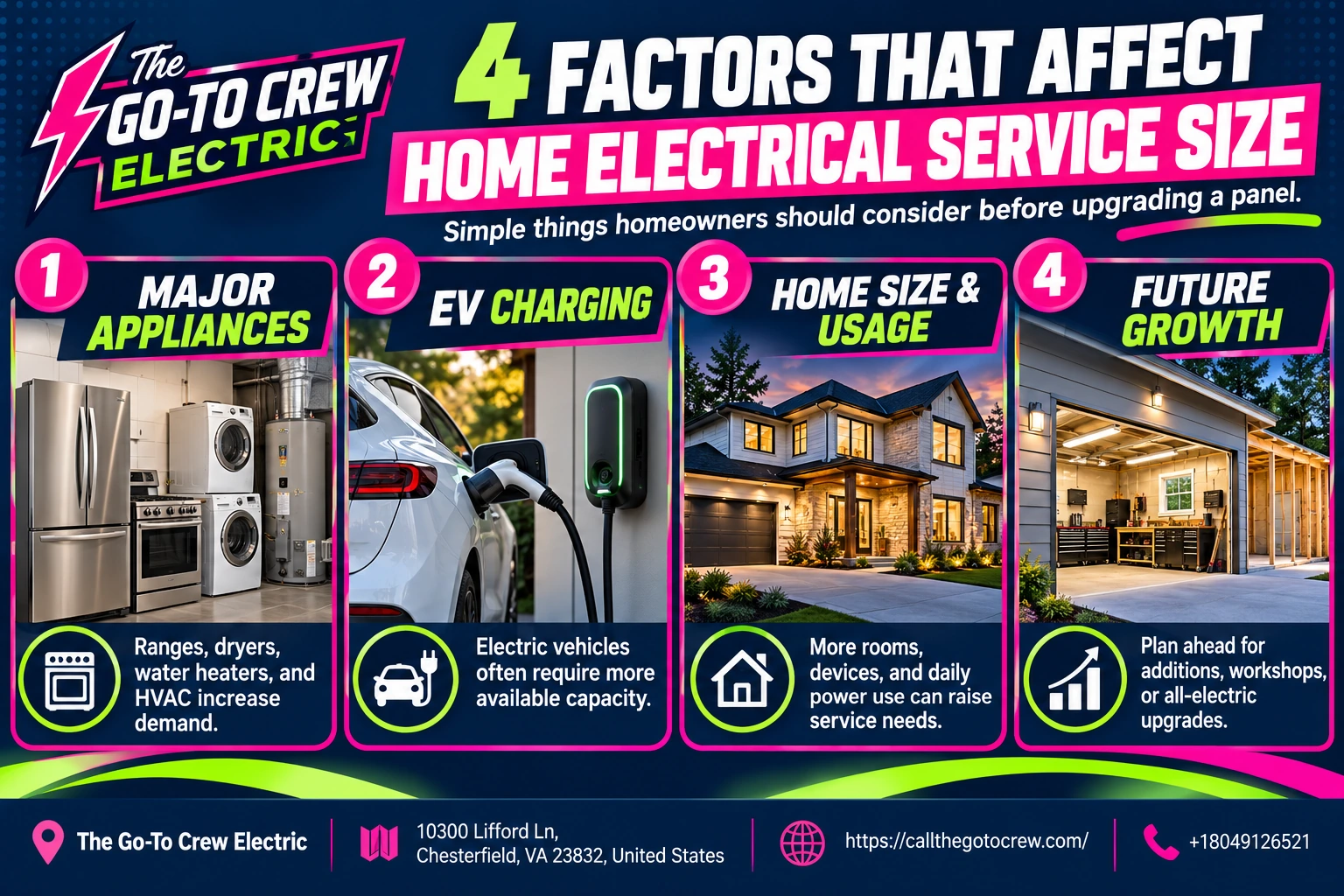
The largest impact usually comes from equipment that uses substantial amounts of electricity for heating, cooling, motors, or vehicle charging.
Common high-demand loads include:
Electric heating
Electric resistance heat can add a substantial load. Heat-pump systems also need to be accounted for, particularly when auxiliary electric heat is involved.
Electric water heating
Traditional tank-type electric water heaters and some other electric water-heating systems add significant fixed loads.
Electric ranges and ovens
Electric cooking equipment is specifically included in residential service load calculations.
Clothes dryers
Electric dryers can represent another large dedicated load.
Air conditioning and heat pumps
Heating and cooling equipment is specifically considered in NEC dwelling-unit load calculations.
EV chargers
Home EV charging can add one of the most significant new electrical loads many homeowners install today.
The more of these systems a home uses electrically, the more important an accurate load evaluation becomes.
How Do EV Chargers Affect Service Capacity?
An EV charger can materially change a home’s electrical load, particularly at higher charging rates.
Under the 2020 NEC—the electrical code currently referenced by Virginia—electric vehicle charging is treated as a continuous load for electrical sizing purposes. NEC provisions require service and feeder capacity to account for the charging equipment’s rated load.
That does not mean installing a Level 2 charger automatically requires upgrading to 200-amp service.
The Go-To Crew Electric’s existing EV guidance notes that many homeowners can install an EV charger without a panel upgrade when sufficient capacity already exists. Other homes may use a lower charging rate or appropriate load-management strategy, while some do require an electrical service upgrade.
Before choosing the charger, an electrician should consider:
- Existing service size
- Current household load
- Charger amperage
- Desired charging speed
- Other major appliances
- Panel condition
- Available breaker space
- Whether approved load management is appropriate
Learn more about home charging on our EV charger installation page.
Is 100-Amp Service Enough for a Modern Home?
It can be.
A 100-amp service is not automatically obsolete simply because newer homes often have higher-capacity electrical systems.
A home may operate comfortably on 100 amps when it has relatively modest electrical demand—for example, if major heating, cooking, or water-heating loads use gas.
The important question is whether the home’s calculated load fits within the available service capacity.
A 100-amp service deserves closer evaluation when a homeowner plans to add several significant electrical loads, such as:
- Level 2 EV charging
- Electric range
- Electric dryer
- Heat pump
- Electric water heater
- Hot tub
- Workshop equipment
Older homes also deserve attention because electrical demand may have grown considerably since their original electrical systems were installed. ESFI recommends professional electrical inspection for older homes and homes that have added major appliances because many older electrical systems were not designed around today’s usage patterns.
When Does 200-Amp Service Make More Sense?
A 200-amp service may make sense when the home’s calculated demand requires it or when a major renovation substantially increases expected electrical use.
Situations that may push demand upward include:
- An all-electric home
- Multiple HVAC systems
- Electric resistance backup heat
- One or more EV chargers
- Electric cooking
- Electric water heating
- Electric clothes drying
- Hot tubs or pools
- Large workshops
- Major additions
It may also make sense to consider future electrical plans during a major service replacement.
For example, a homeowner replacing aging service equipment today may already know they plan to add:
- A second EV
- A heat pump
- Induction cooking
- An electric water heater
Those future loads can be discussed during the service evaluation.
However, upgrading to 200 amps should still be based on the existing system, calculated demand, utility requirements, and realistic future loads—not a blanket assumption that every home needs the largest common residential service.
What Are the Signs Your Electrical Service May Be Too Small?
Certain symptoms can indicate that the electrical system deserves professional evaluation.
ESFI lists warning signs of an overloaded electrical system that include:
- Frequent breaker trips
- Lights dimming when other equipment turns on
- Buzzing from switches or outlets
- Discolored outlets
- Appliances that seem underpowered
Other reasons to request a capacity evaluation include:
- You are adding an EV charger
- You are converting several gas appliances to electric
- You are adding a major home addition
- You are installing new HVAC equipment
- Your panel lacks practical room for planned circuits
- Several major electrical loads have been added over time
These signs do not automatically mean the service is undersized.
Frequent trips or dimming could instead involve:
- One overloaded branch circuit
- Loose wiring
- A failing breaker
- Voltage-drop problems
- Equipment faults
Diagnosis matters before recommending a service upgrade.
How Do Electricians Calculate Required Service Size?
Electricians use a structured load calculation rather than estimating based on square footage alone.
The NEC contains dwelling-unit load calculation methods that account for general household loads and major appliances using prescribed rules and demand factors.
For an existing home that is adding new loads, NEC provisions also provide methods for determining whether the existing service or feeder has sufficient capacity to support additional equipment. The calculation can include existing and proposed fixed appliances, ranges, dryers, water heaters, EV charging equipment, and heating or air-conditioning loads.
A professional evaluation may include:
- Confirming the existing service rating.
- Identifying major electrical appliances.
- Reviewing heating and cooling equipment.
- Including proposed new loads.
- Applying the applicable load-calculation method.
- Comparing calculated demand with existing service capacity.
- Checking panel condition and circuit space separately.
This last point matters.
Panel space and service capacity are not the same thing.
A panel can have empty breaker spaces but insufficient overall service capacity for a major new load.
Likewise, a panel can be physically full while the service still has adequate electrical capacity.
When Should You Consider an Electrical Service Upgrade?
An upgrade may be appropriate when a professional evaluation shows that the existing service cannot safely accommodate current or planned electrical demand.
Common situations include:
- A load calculation exceeds available service capacity
- The home is undergoing major electrification
- An EV charger or other large load cannot be accommodated
- An addition substantially increases electrical demand
- Existing service equipment is being replaced and greater capacity is justified
- Panel or service equipment has other condition or safety issues
Do not assume repeated breaker trips should be solved with a larger main breaker.
The service conductors, meter equipment, panel, disconnects, utility connection, and other components must all be coordinated for the service rating.
Virginia currently enforces its 2021 statewide code cycle, which references the 2020 National Electrical Code.
The Go-To Crew Electric provides electrical panel installation, maintenance, repair, and upgrades and also provides EV charger installation throughout Richmond and surrounding communities.
Learn more about our electrical panel services or visit our Richmond electrician page for local electrical service.
FAQs
Is 100 amps enough for a house?
It can be.
A 100-amp service may adequately support a home with modest electrical demand, particularly when major heating, water-heating, or cooking loads use another fuel.
The proper answer requires a load calculation based on the home’s actual equipment and planned additions.
Is 200-amp service now required for every modern home?
No.
The NEC establishes a 100-amp minimum service-disconnect rating for a one-family dwelling, but the actual service must also be large enough for the calculated load.
A home’s specific demand determines whether 100, 150, 200 amps, or another appropriate service configuration is needed.
Is 150-amp service enough for an EV charger?
Possibly.
The answer depends on how much existing capacity remains and the charging equipment’s load.
EV charging is considered a continuous electrical load, so it must be included appropriately in service and feeder sizing.
Does a Level 2 EV charger require 200-amp service?
Not automatically.
The Go-To Crew Electric notes that many homes can accommodate EV charging without a panel upgrade, depending on existing loads, available capacity, charger settings, and possible load-management options.
A load evaluation should come before the decision to upgrade.
Does a larger house automatically need a larger electrical service?
No.
Square footage contributes to general-load calculations, but major electrical appliances and equipment can have a much larger effect on total demand.
A smaller all-electric home with EV charging may have higher electrical demand than a larger home using gas for several major appliances.
Can I tell my service size by looking at the main breaker?
The main breaker rating can provide an important clue, but an electrician may need to verify the complete service equipment, conductors, and configuration before confirming the home’s actual service capacity.
Do not remove protective panel covers to investigate service wiring yourself.