You’re planning a kitchen upgrade and have decided an induction cooktop might be the right choice. You like its responsive cooking controls and smooth surface, and you’re ready to replace your current appliance.
But before you order the cooktop, there’s one important question: Can your home’s electrical system support it?
The electrical requirements for induction cooktop installation depend on the specific appliance, existing circuit, wiring, and available electrical capacity. Some homes may already have a suitable electrical connection. Others may need a new dedicated circuit, wiring changes, or additional electrical work before installation.
At The Go-To Crew Electric, we help homeowners in Chester, VA, evaluate electrical systems for home improvements and appliance upgrades.
If you’re replacing a gas cooktop, switching from a traditional electric model, or remodeling your kitchen, here’s what to check before installation day.
Quick Answer: What Electrical Work May an Induction Cooktop Need?
An induction cooktop may require a properly rated electrical circuit, compatible wiring, appropriate grounding, and a connection method that meets the manufacturer’s installation instructions.
The specific work depends on the cooktop model and the home’s existing electrical setup.
For example, replacing an older electric cooktop with an induction model doesn’t automatically mean the existing circuit is suitable.
The new appliance may have different electrical requirements.
Likewise, replacing a gas cooktop can involve additional electrical work because the existing gas appliance may have used electricity only for ignition or controls.
An electrician may need to evaluate:
- The appliance’s electrical specifications
- The existing circuit and breaker
- Wire type, condition, and suitability
- The required electrical connection
- Available capacity in the home’s electrical system
- Applicable codes and installation requirements
An induction cooktop doesn’t automatically require a new electrical panel. However, the panel and service capacity should be evaluated before deciding whether the existing system can accommodate the appliance.
What Are Typical Induction Cooktop Power Requirements?
Induction cooktops use electrical energy to create a magnetic field that heats compatible cookware.
Unlike a traditional electric cooktop, which heats a cooking element that transfers heat to the pan, an induction unit generates heat directly in suitable cookware.
That difference changes how cooking works, but it doesn’t eliminate the need for appropriate electrical capacity.
Electrical Requirements Vary by Model
Induction cooktops come in different sizes and configurations.
A compact unit with fewer cooking zones may have different electrical demands from a larger built-in cooktop designed for multiple pans.
Power-sharing features and manufacturer design can also influence a model’s electrical specifications.
For that reason, homeowners shouldn’t assume that all induction cooktops use the same breaker size or wiring.
The required voltage, circuit protection, and connection arrangement must come from the selected appliance’s documentation.
Check the Installation Manual
Before purchasing, find the manufacturer’s installation instructions for the exact model.
These should identify relevant electrical requirements, which may include:
- Supply voltage and frequency
- Required branch-circuit arrangement
- Circuit protection specifications
- Grounding requirements
- Approved wiring and connection methods
- Electrical junction box or receptacle requirements
- Installation clearances and access considerations
Some cooktops are designed for permanent wiring connections rather than a standard plug-in arrangement.
Others may have different installation requirements.
The electrician needs the exact model information to determine what’s appropriate.
Avoid Choosing a Breaker Based on Cooktop Size Alone
A larger cooktop isn’t automatically assigned one particular breaker rating.
Likewise, a smaller cooktop shouldn’t be assumed to work on any nearby kitchen circuit.
Manufacturer specifications and applicable electrical rules determine the installation requirements.
Installing an oversized breaker or using unsuitable wiring can create serious safety concerns.
That’s why circuit design should be handled by a qualified electrician.
Can an Existing Kitchen Circuit Support an Induction Cooktop?
Possibly.
An existing circuit may be suitable when its wiring, protection, configuration, and available capacity match the new appliance’s requirements.
However, this should be verified before the cooktop is installed.
Replacing a Traditional Electric Cooktop
If your kitchen already has an electric cooktop, there may be an existing branch circuit intended for cooking equipment.
That can be a useful starting point.
But the new induction cooktop may require different electrical characteristics.
The electrician should compare the existing installation with the new appliance’s specifications.
Important factors include the circuit’s rating, conductor suitability, grounding, and connection method.
A circuit that worked with the old appliance isn’t automatically appropriate for the replacement.
Switching From a Gas Cooktop
Moving from gas to induction often requires more electrical planning.
A gas cooktop may use electricity for controls or ignition while relying on gas for cooking heat.
An induction cooktop depends on electricity for the cooking process itself.
As a result, the existing electrical supply for the gas appliance may not be adequate.
A new appropriately designed circuit may be required.
The gas connection must also be addressed by a properly qualified professional as part of the appliance conversion.
What If the Circuit Is Already Used by Another Appliance?
Your electrician will need to determine whether the circuit arrangement is permitted for the new cooktop.
Don’t assume that an available connection can support additional equipment simply because it is physically nearby.
Kitchen electrical systems may contain circuits for refrigerators, dishwashers, ovens, countertop outlets, and other appliances.
These circuits serve different purposes and may have different requirements.
Connecting a new induction cooktop to an unsuitable circuit isn’t an acceptable shortcut.
Does an Induction Cooktop Usually Need a Dedicated Circuit?
Many built-in induction cooktops require an individual branch circuit.
This means the circuit is intended to supply the cooktop rather than multiple unrelated electrical loads.
However, the exact requirement must be confirmed in the installation manual for the appliance.
Why Dedicated Circuits Are Common
An induction cooktop can represent a substantial electrical load.
A dedicated circuit allows its electrical supply to be designed around the appliance’s specified requirements.
This helps prevent unrelated appliances from being added to the same branch circuit without proper evaluation.
It can also make future electrical troubleshooting more straightforward.
What Does the Manufacturer Require?
Some manufacturer installation instructions explicitly specify an individual, properly grounded branch circuit.
Others provide requirements that must be interpreted along with applicable electrical codes.
An electrician should verify both.
Homeowners should not choose a circuit solely because its breaker appears large enough.
The wiring, connection method, grounding, and other conditions must also be suitable.
A Dedicated Circuit Isn’t the Same as a New Panel
A common misunderstanding is that installing a dedicated circuit automatically requires replacing the electrical panel.
These are separate decisions.
A dedicated circuit is a branch circuit serving the appliance.
The electrical panel distributes electricity through the home’s branch circuits.
If the existing panel and service have sufficient capacity and the equipment is suitable, a new circuit may be possible without a complete panel upgrade.
That determination requires professional evaluation.
How Panel Capacity Affects Installation
Before adding a substantial electrical load, the home’s available electrical capacity needs to be considered.
Your electrical panel may supply many appliances and systems, including heating, cooling, laundry equipment, and existing kitchen appliances.
Adding an induction cooktop changes the home’s electrical load calculations.
Panel Space and Electrical Capacity Are Different
A panel may have physical space for another breaker but still require additional evaluation before supporting a new load.
Likewise, a panel that appears full may not automatically require complete replacement.
These are different issues.
An electrician may need to evaluate the equipment’s condition, approved circuit arrangements, and the home’s calculated electrical demand.
Available breaker positions alone don’t establish that a new appliance can be safely installed.
What Is an Electrical Load Calculation?
A load calculation is a method of evaluating the electrical demand that the installation must be designed to serve.
It accounts for applicable connected equipment and uses the calculation rules required by the governing electrical code.
An electrician may use this process when determining whether an induction cooktop can be added to the existing system.
The result helps establish whether the proposed installation fits within available electrical capacity.
You shouldn’t have to estimate this by adding up the labels on household appliances yourself.
Other Kitchen Upgrades Can Affect the Plan
If you’re remodeling the kitchen, think beyond the cooktop.
You might also be installing a new wall oven, dishwasher, or other electrical equipment.
Those changes can affect the overall project.
It can be more practical to discuss the entire planned appliance package with your electrician before the renovation begins.
This allows electrical requirements to be considered together rather than discovering another necessary change after cabinets and countertops are finished.
Cooktop vs. Range: Are the Electrical Connections Different?
Yes, they can be.
A built-in induction cooktop and a freestanding induction range are different appliances.
A cooktop provides the cooking surface, while a range combines the cooktop and oven in one unit.
That distinction can affect the electrical installation.
Built-In Induction Cooktops
A built-in cooktop is typically installed into a countertop opening.
Some models are designed to connect through a junction box using the manufacturer’s specified wiring arrangement.
Electrical access, connection location, and cabinet clearances need to be planned before the countertop installation.
The exact connection requirements vary by model.
Freestanding or Slide-In Induction Ranges
An induction range includes an oven as well as an induction cooking surface.
Depending on the model, its electrical connection requirements may differ from those of a standalone cooktop.
Some ranges are supplied using an approved cord-and-receptacle arrangement, while other configurations may have different requirements.
An electrician should check the exact manufacturer’s instructions.
Don’t assume that a connection for a previous electric range will automatically suit the new induction range.
Separate Cooktop and Wall Oven
Some homeowners choose a built-in induction cooktop and a separate wall oven.
These are two appliances with their own installation requirements.
Depending on manufacturer instructions and applicable electrical rules, they may require separate electrical arrangements.
The electrician should consider both appliances during project planning.
This is especially important if you’re replacing one combined range with separate cooking equipment.
Could Older Wiring Need to Be Upgraded?
Yes.
Older wiring isn’t automatically unsafe simply because of its age, but its condition and suitability matter.
An induction cooktop may require a different electrical supply from the appliance being replaced.
Existing Wiring May Not Match the New Appliance
The previous circuit may have different voltage, conductor, grounding, or protection characteristics from those required by the induction unit.
Even if the connection is in the right location, the electrical specifications may not match.
An electrician can determine whether the existing wiring is suitable or whether a new circuit is needed.
Grounding Must Be Appropriate
Proper grounding is an important part of electrical safety.
Manufacturer instructions identify the required electrical grounding arrangement.
An electrician should verify that the proposed installation meets those requirements.
Never use adapters, improvised connections, or modifications intended to bypass grounding requirements.
Wiring Condition Matters
A professional evaluation may identify damaged insulation, unsuitable connections, or other conditions that need attention.
These problems should be addressed before the new appliance is placed into service.
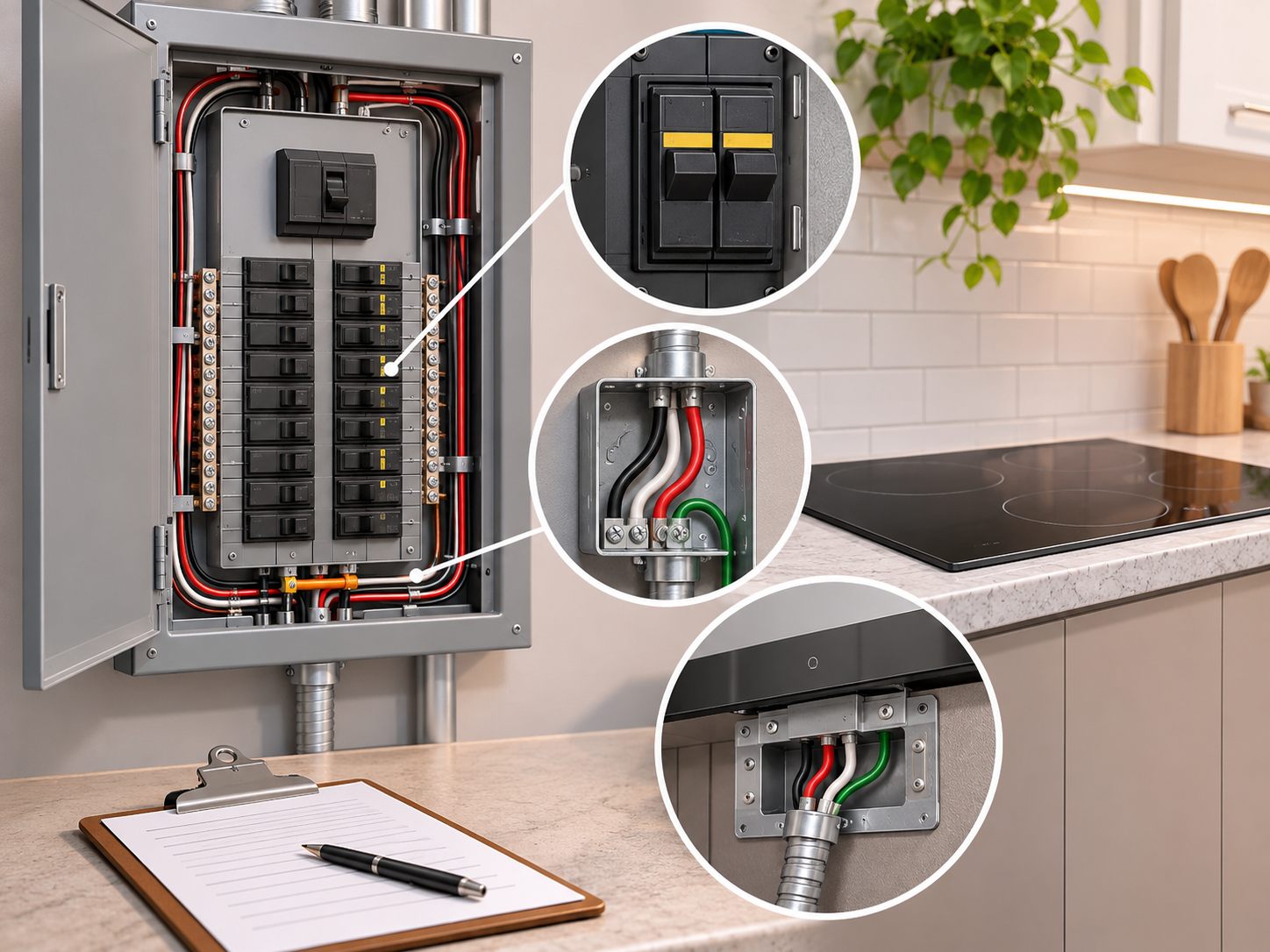
If your project requires a new circuit or changes to the existing supply, our electrical wiring services provide more information about how The Go-To Crew Electric helps homeowners with wiring projects.
What Should Be Checked Before Installation Day?
One of the best ways to avoid unexpected delays is to address the electrical requirements before ordering the appliance or scheduling countertop work.
A little planning can prevent discovering that the new cooktop can’t be connected to the existing electrical supply.
Start With the Exact Model Number
Choose the cooktop model you’re considering and obtain its installation manual.
If you’re comparing several models, keep the specifications for each one.
An electrician can explain whether the electrical differences are important for your home.
Confirm the Existing Electrical Setup
Have a qualified electrician evaluate the current circuit and available capacity.
If you’re replacing a gas cooktop, discuss whether a new circuit needs to be installed.
If you’re replacing an electric cooktop, ask whether the existing branch circuit can be reused.
Don’t rely on the appearance of an outlet or breaker as proof of compatibility.
Coordinate With Your Kitchen Contractor
A built-in cooktop may require specific clearances, connection locations, and access arrangements.
Cabinetmakers, countertop installers, appliance installers, and electricians may each have different responsibilities.
Confirm who is handling the electrical preparation before installation day.
The appliance manufacturer’s instructions should guide the approved installation arrangement.
Discuss Permits and Inspections
Electrical modifications may require permits or inspections depending on the work and local requirements.
Ask your electrician what applies to the planned installation in Chester.
Permit requirements should be confirmed with the applicable local authority rather than assumed.
Pre-Installation Checklist
| What to confirm | Why it matters |
| Exact cooktop model | Establishes manufacturer requirements |
| Electrical specifications | Determines the necessary supply characteristics |
| Existing circuit suitability | Shows whether wiring can be reused |
| Dedicated circuit requirement | Clarifies the branch-circuit arrangement |
| Panel and service capacity | Determines whether additional load can be accommodated |
| Connection type and location | Helps coordinate cabinet and countertop work |
| Other planned appliances | Allows broader electrical planning |
| Permits and inspection requirements | Helps keep the project compliant |
Do not open the electrical panel, modify wiring, or attempt to connect the cooktop yourself. Electrical work should be performed by a qualified professional following the manufacturer’s instructions and applicable code requirements.
When Is an Electrical Panel Upgrade Necessary?
Not every induction cooktop installation requires a panel upgrade.
The need for one depends on the existing electrical system and the results of the professional assessment.
When the Existing System May Be Adequate
If the electrical service has sufficient calculated capacity, the panel is suitable, and the required branch circuit can be installed appropriately, replacing the panel may not be necessary.
The electrician may recommend a new circuit or limited electrical modifications instead.
This is why an inspection and load calculation can be useful before making major renovation decisions.
When an Upgrade May Be Considered
A panel or service upgrade may be appropriate when the existing equipment cannot safely support the proposed installation.
Potential reasons include insufficient electrical capacity, unsuitable or deteriorated equipment, or limitations affecting the proposed circuit installation.
The specific recommendation depends on the home’s electrical system.
A full replacement shouldn’t be presented as the default solution without evaluating the actual conditions.
Ask What Problem the Upgrade Would Solve
If a panel upgrade is recommended, ask your electrician to explain why.
Is the concern the calculated electrical demand?
Is the panel equipment unsuitable?
Does the installation require an electrical service change?
Understanding the reason helps you evaluate the proposal.
You can learn more about our electrical panel services if an assessment identifies a panel-related concern.
Induction Cooktop Electrical Planning in Chester, VA
Whether you’re updating an existing Chester kitchen or planning a larger renovation, electrical work should be considered early in the process.
The right time to assess the circuit is before the new cooktop is installed not after the old appliance has been removed.
Tell Us What You’re Replacing
At The Go-To Crew Electric, we encourage homeowners to share whether they’re replacing a gas cooktop, electric cooktop, or full range.
Each project may have different electrical considerations.
It also helps to know whether you’re changing cabinets, countertops, or other kitchen appliances.
Have the Electrical Requirements Reviewed
We can discuss the electrical needs of your kitchen upgrade and evaluate the appropriate wiring or panel concerns within our scope of service.
A professional assessment can help determine whether the existing system is suitable or whether changes are needed.
The final installation plan should reflect the selected model’s requirements and applicable codes.
Plan Before the Kitchen Is Finished
If electrical work is needed, it’s generally easier to coordinate it while the renovation is still being planned.
Waiting until the appliance arrives may create scheduling problems or require changes to recently completed work.
For homeowners preparing an induction cooktop upgrade, the goal is to establish a suitable electrical installation before the cooking appliance is put into service.
Learn more about our local services through our electrician in Chester, VA page.
FAQs About Induction Cooktop Wiring
Does an Induction Cooktop Need a Dedicated Circuit?
Many built-in induction cooktops require an individual branch circuit, but requirements vary by model. The installation manual specifies the necessary electrical supply and protection. An electrician should confirm that the circuit meets the manufacturer’s instructions and applicable electrical codes.
Can I Use My Existing Electric Cooktop Wiring for Induction?
Possibly. The existing wiring may be suitable if the circuit, conductor characteristics, grounding, and protection match the new cooktop’s requirements. An electrician should verify compatibility before the appliance is connected.
Do I Need a Panel Upgrade to Install an Induction Cooktop?
Not automatically. Some homes have adequate electrical capacity and suitable panel equipment for the proposed installation. Others may require additional work. A qualified electrician can evaluate the existing system and determine whether a panel or service upgrade is necessary.
Can I Replace a Gas Cooktop With Induction?
Yes, but the electrical work may be more involved. A gas cooktop’s existing electrical connection may not be suitable for an induction unit. A properly designed circuit may be required, and the gas supply must be handled by a qualified professional.
Are Induction Cooktops Wired Differently From Electric Ranges?
They can be. Built-in cooktops and freestanding ranges may have different electrical specifications and connection methods. Some cooktops require permanent wiring arrangements, while particular range models use approved cord-and-receptacle connections. Always follow the instructions for the exact appliance.
Should an Electrician Inspect the Circuit Before I Buy an Induction Cooktop?
An early electrical assessment is a good idea, especially if you’re converting from gas, updating an older kitchen, or installing multiple new appliances. Knowing the model’s requirements and the home’s available electrical capacity can help prevent installation surprises.
Planning an Induction Cooktop Upgrade? Contact The Go-To Crew Electric
An induction cooktop can be an excellent addition to a kitchen renovation, but the electrical preparation matters.
The right installation depends on the appliance specifications, the existing wiring, and the home’s available electrical capacity.
At The Go-To Crew Electric, we help homeowners in Chester, VA, evaluate electrical wiring and panel concerns before home improvement projects move forward.
If you’re preparing to install an induction cooktop, we can discuss your plans and help determine whether electrical modifications may be needed.
Contact The Go-To Crew Electric to request an electrical assessment before installation day.
Getting the electrical requirements checked early can help you move forward with a kitchen upgrade that’s properly planned for your home.