
In most homes, a full-size electric range needs its own properly sized 240-volt circuit rather than sharing power with ordinary kitchen outlets or lighting.
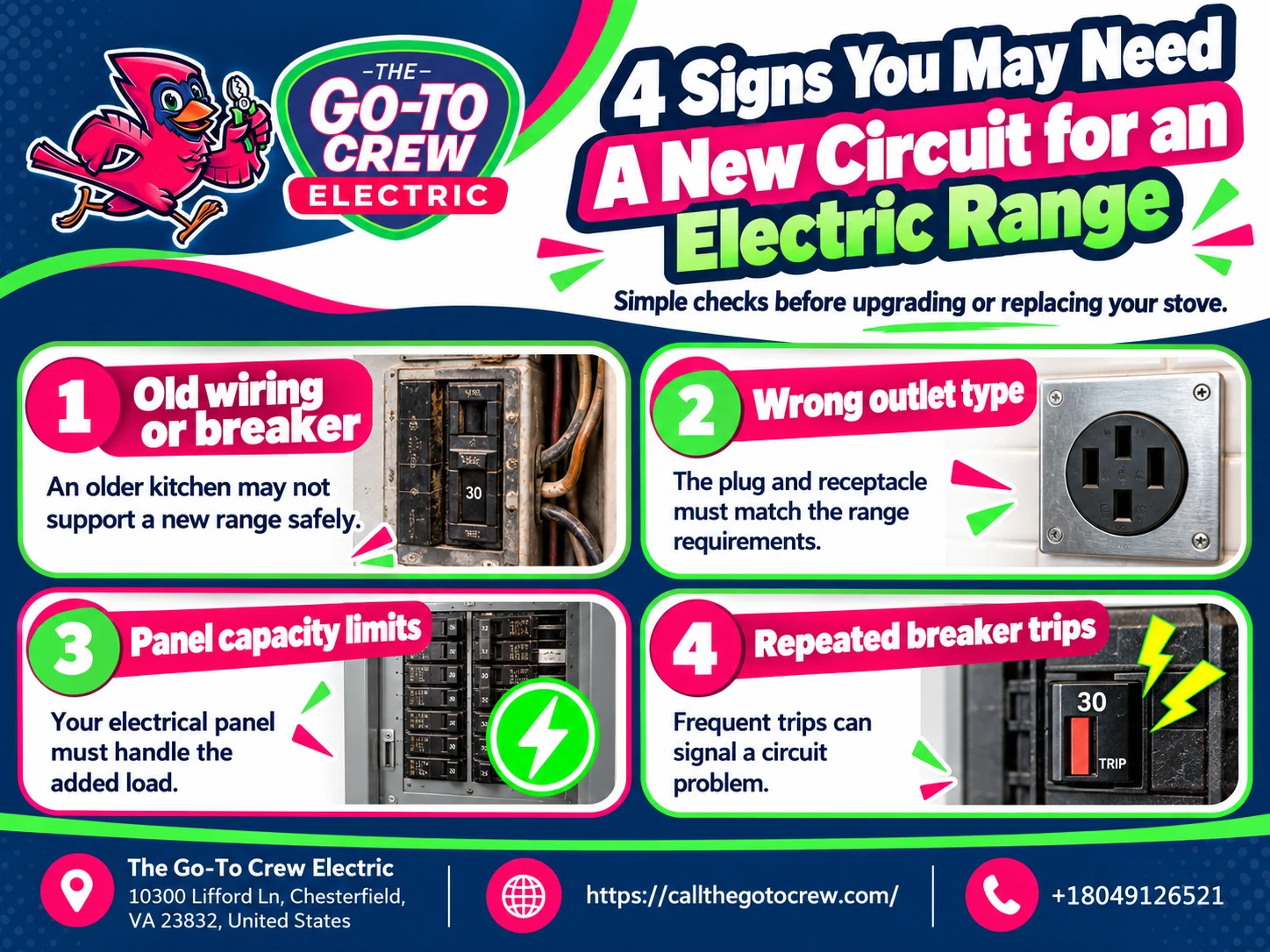
Whether you actually need a new circuit depends on what is already installed. If you are replacing one electric range with another, an existing range circuit may be usable if its voltage, breaker size, wiring, receptacle, grounding, and condition match the new appliance’s requirements. If you are switching from a gas range to an electric model, new high-voltage wiring is much more likely to be needed.
Many full-size electric ranges specify 40- or 50-amp circuit protection, but the exact requirement comes from the appliance’s model-specific rating plate and installation instructions. Current Whirlpool installation instructions, for example, specify 40- or 50-amp protection for many ranges in the 8.8–16.5 kW range and 50 amps for higher-rated models.
Before the appliance is delivered, it is worth having the existing circuit checked rather than assuming the old outlet will work with the new range.
Does an Electric Range Need a Dedicated Circuit?
A full-size electric range will generally have a dedicated branch circuit that serves the range rather than other household devices.
Electric ranges are high-demand appliances. Their heating elements, oven, controls, and other components can draw substantially more power than ordinary countertop appliances.
The Go-To Crew Electric’s existing guidance on dedicated circuits identifies ranges among the common appliances that may require dedicated electrical circuits, while emphasizing that the final requirement depends on the appliance specifications, existing wiring, and applicable electrical code.
A dedicated range circuit helps ensure that:
- The conductors are sized for the appliance
- The breaker provides appropriate circuit protection
- Other household loads are not added to the same high-demand circuit
- The electrical connection matches the manufacturer’s requirements
This does not mean every electric cooking appliance uses the same circuit.
A freestanding electric range, wall oven, cooktop, compact range, and induction appliance may all have different electrical specifications. Always start with the actual appliance rather than choosing a breaker based only on the words “electric range.”
What Are the Typical Circuit Requirements for an Electric Range?
Many conventional full-size electric ranges operate on a 120/240-volt electrical supply and use circuit protection in the 40- or 50-amp range.
For example, current Whirlpool installation guidance shows:
- Many 8.8–16.5 kW ranges: 40- or 50-amp circuit protection
- Higher-rated 16.6–22.5 kW ranges: 50-amp circuit protection
The instructions also require the electrical connection and conductor size to match the range rating and applicable electrical codes.
Those figures are useful examples not universal sizing rules.
Your range may have different requirements based on:
- Appliance wattage
- Model and manufacturer
- Number of ovens
- Cooktop technology
- Additional features
- Voltage available in the home
The manufacturer’s installation manual and rating plate should determine the final electrical specifications.
An electrician can then verify that the breaker, conductors, receptacle or hardwired connection, and electrical panel are all suitable for that requirement.
What Changes Are Needed When Switching From Gas to Electric?
A gas-to-electric range conversion often requires more electrical work than a straightforward appliance replacement.
A gas range may use electricity for ignition, controls, lights, or convection fans, but its cooking heat primarily comes from gas. As a result, it may only have an ordinary 120-volt receptacle behind it.
A full-size electric range typically requires a much larger 120/240-volt circuit.
A gas-to-electric conversion may therefore involve:
- Installing a new dedicated range circuit
- Running appropriately sized cable from the electrical panel
- Installing the proper range receptacle or connection
- Adding the correct circuit breaker
- Evaluating electrical panel capacity
- Obtaining required electrical permits
- Coordinating the electrical work with gas-line changes
Do not assume that the existing gas-range receptacle can power the replacement electric range.
In Chesterfield County, adding wiring for appliances or equipment is among the electrical projects that require an electrical permit, with rough-in and final electrical inspections applicable to that work.
The Go-To Crew Electric provides new and upgraded wiring for residential renovation projects, including systems designed around modern electrical loads.
Learn more on our electrical wiring page.
Does an Electric Range Need a Special Outlet?
Many modern cord-connected electric ranges use a large 4-prong range receptacle rather than a standard household outlet.
One common configuration is a NEMA 14-50R receptacle, but the correct connection must match the specific appliance and installation requirements.
Current Whirlpool instructions for certain ranges specify a UL- or CSA-listed range cord intended for a 14-50R wall receptacle. Other ranges may be configured differently or may permit a direct-wired installation.
Older homes may have existing 3-wire range connections.
That does not mean a homeowner should simply buy an adapter or change a cord to make a new appliance fit. The electrician should evaluate:
- Number and type of conductors
- Equipment grounding
- Receptacle configuration
- Circuit amperage
- Wire size
- Existing wiring condition
- Manufacturer instructions
- Current code requirements
If the old electrical connection does not match the new range, the safe solution is to determine what electrical changes are required not to improvise a connection.
Can Existing Wiring Be Used for a New Electric Range?
Sometimes.
An existing range circuit may be reusable when it is correctly sized and compatible with the new appliance.
An electrician should verify:
- The circuit voltage
- Breaker rating
- Conductor size
- Conductor material
- Grounding arrangement
- Number of conductors
- Receptacle or connection type
- Wiring condition
- Range manufacturer’s specifications
For example, suppose the old range operated on a 40-amp circuit but the new model requires a 50-amp circuit.
Simply replacing the 40-amp breaker with a 50-amp breaker is not automatically an acceptable solution. The existing conductors and all associated equipment must be appropriate for the higher circuit rating.
Circuit breakers are selected as part of a complete electrical system. The Go-To Crew Electric’s breaker service emphasizes proper breaker selection, installation, and evaluation rather than treating a breaker as an isolated component.
A larger breaker should never be installed merely to stop the existing breaker from tripping.
How Does Range Size Affect Electrical Requirements?
Physical size can influence electrical demand, but it is not reliable enough to size the circuit by itself.
A larger range may contain:
- More heating elements
- Higher-output burners
- Double ovens
- Larger oven cavities
- Additional warming elements
- High-power induction components
Those features can increase the connected electrical load.
However, two ranges of the same physical width can have different electrical ratings.
That is why the kilowatt rating and manufacturer instructions matter more than simply whether the range is 30 or 36 inches wide.
Whirlpool installation documentation illustrates this variation by matching circuit protection to appliance electrical ratings rather than applying one universal breaker size to every range.
Before purchasing the appliance, check its electrical specifications. This is particularly helpful when comparing larger ranges, induction models, or appliances with multiple ovens.
Does Your Electrical Panel Have Enough Capacity?
Installing the correct range circuit is only part of the project.
Your electrical service also needs enough capacity for the added load.
This becomes particularly important during a gas-to-electric conversion because the home may be adding a significant electrical load that did not previously exist.
An electrician may evaluate:
- Electrical service rating
- Existing calculated household load
- Heating and cooling loads
- Electric water heating
- Clothes dryer
- EV charging
- Other major appliances
- Planned electric range
- Available breaker positions
- Panel condition
An empty breaker space does not automatically prove that the home has enough electrical capacity.
The space tells you there may be room for another breaker. It does not determine whether the electrical service can support the added demand.
Likewise, a full panel does not automatically mean the entire electrical service needs to be upgraded. Circuit distribution and total service capacity are separate questions.
For homes undergoing broader electrification such as adding an electric range, EV charger, heat pump, and electric water heater a formal load evaluation becomes especially valuable.
When Is a New Breaker Needed for an Electric Range?
A new circuit will normally require a compatible breaker sized for that circuit and appliance.
A breaker may also need replacement when an existing range circuit is being evaluated and the installed breaker is:
- Incorrectly sized
- Damaged
- Incompatible with the panel
- No longer functioning properly
- Inappropriate for the new appliance requirements
The breaker’s rating cannot be selected independently from the wiring.
The breaker, wire size, appliance load, connection method, and electrical panel must work together as a properly designed circuit.
The Go-To Crew Electric provides circuit-breaker installation, repair, and replacement and evaluates breaker problems including repeated trips, failure to reset, buzzing, and visible heat damage.
For more information, visit our circuit breaker page.
What Should Be Checked Before Installing the Appliance?
Ideally, have the electrical requirements confirmed before the range is delivered.
An electrician may need to check:
The appliance specifications
The model’s installation instructions identify the required voltage, circuit protection, and connection method.
The existing outlet
The receptacle needs to match the range’s approved cord and electrical configuration.
Existing wiring
The conductors should be appropriately sized, correctly configured, and in good condition.
Circuit breaker
The breaker must match the requirements of the branch circuit and appliance.
Panel capacity
The home’s existing electrical demand should be considered, particularly when changing from gas cooking to electric.
Outlet location
The connection must be positioned so the range can be installed properly without crushing the cord or preventing the appliance from sitting correctly.
Local permit and inspection requirements
Chesterfield County currently requires electrical permits when providing new wiring or installing or replacing electrical wiring and specifically lists adding wiring for appliances or equipment among work requiring electrical inspection.
Virginia currently uses the 2021 state code cycle, which incorporates the 2020 National Electrical Code.
Checking these items before delivery can help avoid discovering on installation day that the outlet, circuit, or panel is not ready for the appliance.
When Should You Call an Electrician?
Contact an electrician before installing an electric range when:
- You are switching from gas to electric
- There is no 240-volt range connection
- The existing outlet does not match the new appliance
- You do not know the circuit rating
- The new range requires more amperage than the old one
- The breaker trips when the range operates
- The receptacle or plug shows heat damage
- Wiring appears old or damaged
- The electrical panel has limited space
- Several major electric appliances have recently been added
- You are unsure whether the home has enough electrical capacity
Do not remove panel covers, replace range breakers with larger ones, modify high-amperage receptacles, or attempt to repurpose an incompatible circuit without qualified electrical evaluation.
The Go-To Crew Electric provides wiring upgrades, circuit-breaker services, panel work, inspections, and other residential electrical services in Chester and surrounding communities. Its Chester service page specifically includes electrical wiring, breaker, panel, outlet, inspection, and repair services.
Visit our Chester electrician page for local electrical service.
FAQs
Can I plug an electric range into a normal outlet?
A conventional full-size electric range generally cannot operate from an ordinary 120-volt household receptacle.
Most require a higher-capacity 120/240-volt electrical connection. The exact outlet, voltage, and circuit requirements depend on the range manufacturer’s instructions.
Does every electric range need a 50-amp breaker?
No.
Many ranges use 40- or 50-amp circuit protection, but the correct breaker depends on the appliance rating and manufacturer specifications. Some current Whirlpool ranges, for example, permit 40- or 50-amp protection within certain electrical ratings, while higher-rated models specify 50 amps.
The breaker should never be selected by guesswork.
Can I use my old electric stove circuit for a new range?
Possibly.
If the existing voltage, breaker, wiring, grounding, connection type, and circuit capacity meet the new range’s specifications, the circuit may be reusable.
An electrician should verify compatibility before the new appliance is connected.
Do I need electrical work when replacing a gas range with an electric range?
Often, yes.
A gas range commonly has only a standard 120-volt electrical connection for controls and ignition, while a full-size electric range typically requires a high-capacity 120/240-volt circuit.
That conversion may require new wiring, a new breaker, a new receptacle, and an evaluation of electrical panel capacity.
Can I replace a 40-amp range breaker with a 50-amp breaker?
Not simply because the new range calls for more power.
The conductors, panel equipment, receptacle, and other components must all be suitable for the higher rating. Installing a larger breaker on wiring that is not sized appropriately can create a serious electrical hazard.
Have the existing circuit evaluated before changing breaker size.
Does installing an electric range require an electrical permit in Chester?
If the project involves new or altered electrical wiring, Chesterfield County currently requires an electrical permit. The county specifically lists adding wiring for appliances or equipment among projects requiring rough-in and final electrical inspections.
A straightforward appliance replacement using an already compliant existing circuit may be different, so permit requirements should be confirmed based on the actual project scope.