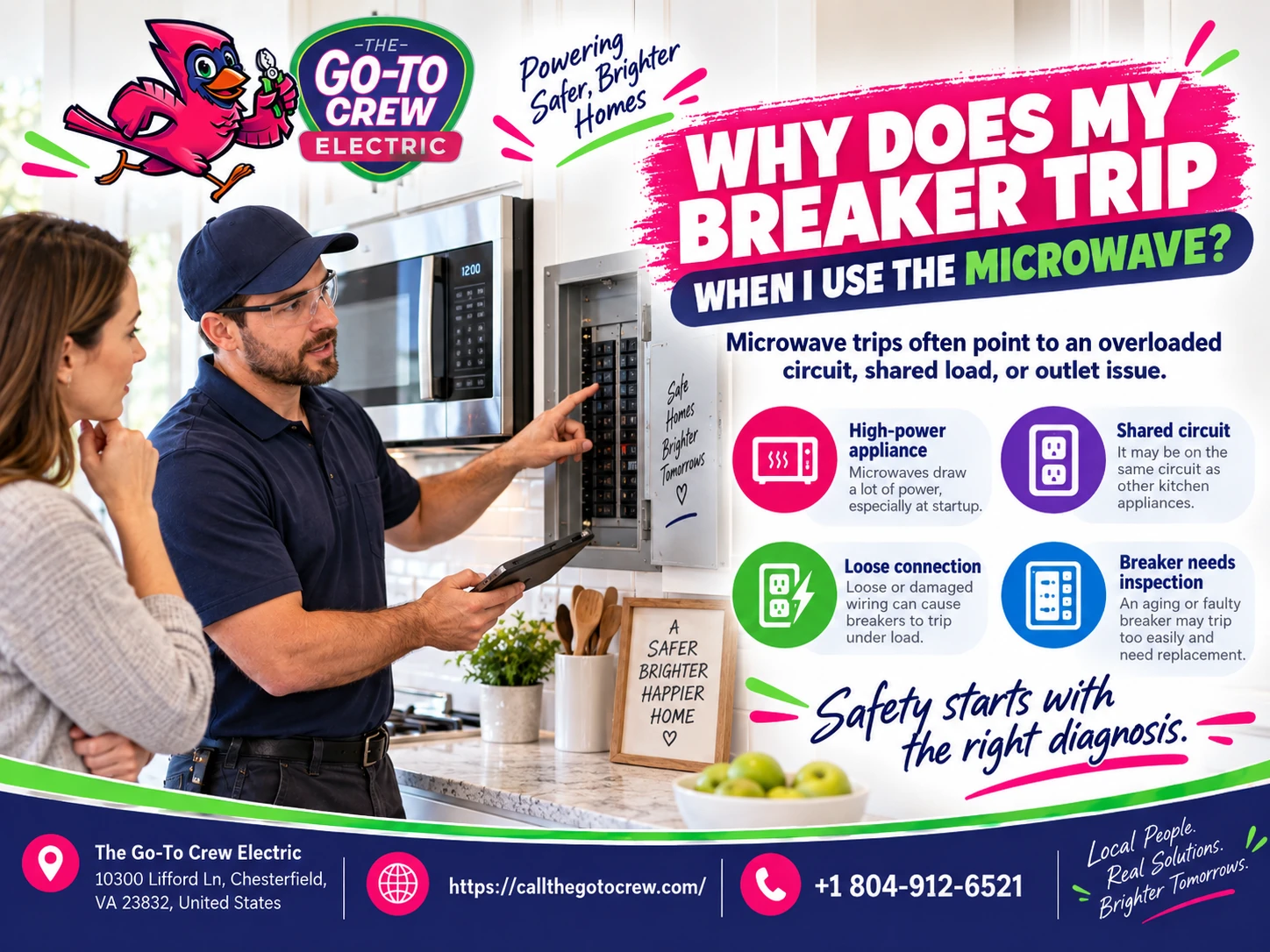
If your breaker trips when using the microwave, the circuit may be carrying more electrical load than it can safely handle. This commonly happens when the microwave shares a circuit with other high-demand kitchen appliances, but repeated trips can also point to a problem with the microwave, outlet, breaker, or electrical wiring.
A circuit breaker is designed to shut off power when it detects an unsafe electrical condition. One trip does not automatically mean there is a serious wiring problem, but a breaker that repeatedly trips every time the microwave runs should not be ignored.
Start with simple observations: note what else was operating when the trip occurred, stop using other high-demand appliances on the same circuit, and watch for warning signs such as heat, burning odors, buzzing, or discoloration.
Do not open the electrical panel, replace the breaker with a larger one, or attempt wiring repairs yourself. If the problem continues, a professional circuit breaker evaluation can determine whether the problem is an overloaded circuit, faulty breaker, appliance issue, or another electrical condition.
Why Does My Breaker Trip When I Use the Microwave?
The breaker may trip because the microwave causes the circuit to exceed its safe electrical capacity.
Microwaves use a significant amount of power while heating food. If the same circuit is also supplying a toaster, coffee maker, air fryer, refrigerator, or another appliance, the combined demand may be more than the circuit is designed to handle.
However, overload is not the only possibility.
A microwave-related trip can also involve:
- A failing or damaged microwave
- A loose or damaged electrical connection
- A problem with the receptacle
- An aging or defective breaker
- A short circuit or ground fault
- Wiring problems
- Multiple high-demand appliances sharing one circuit
The timing of the trip may offer clues, but it does not provide a complete diagnosis.
For example, a breaker that trips when several appliances are running may suggest an overloaded circuit. A breaker that trips immediately every time the microwave starts even when little else is operating deserves closer evaluation.
Repeatedly resetting the breaker without finding the cause is not a solution. The breaker is responding to something, and repeated trips mean that condition should be identified.
Why Do Microwaves Draw So Much Power?
A microwave has to generate enough energy to heat food quickly.
That makes it a relatively high-demand appliance compared with small electronics, lighting, phone chargers, and many other household devices.
The power used by the microwave can also be higher than the cooking wattage advertised prominently on the appliance. Homeowners should use the manufacturer’s electrical specifications rather than assuming the number on the front of the microwave represents its total electrical demand.
This becomes important when multiple kitchen appliances operate at the same time.
Consider a circuit supplying a microwave along with appliances such as:
- Coffee maker
- Toaster
- Electric kettle
- Air fryer
- Blender
- Countertop oven
Each appliance may work normally when used by itself.
Turn several on at the same time, however, and their combined electrical demand may exceed what the circuit can safely supply.
When that happens, the breaker may trip to protect the wiring from overheating.
That protective response is preferable to allowing an overloaded circuit to continue operating.
Can a Shared Circuit Cause the Breaker to Trip?
Yes. A shared circuit is one of the first things to consider when a microwave trips a breaker.
In many kitchens, multiple receptacles or appliances may be connected to the same branch circuit. Two outlets being physically far apart does not necessarily mean they are on different circuits.
Suppose your microwave works normally most of the time but trips the breaker when someone also starts the toaster or air fryer.
That pattern can suggest the combined load is contributing to the problem.
Look at what was running at the same time
When the breaker trips, make a note of everything that was operating.
Pay particular attention to appliances that produce heat or perform high-power cooking tasks.
If the breaker only trips when two or more demanding appliances operate together, stop using those appliances simultaneously until the circuit can be evaluated.
Do not solve an overload by installing a larger breaker
A higher-capacity breaker is not a safe shortcut.
Circuit breakers are selected to protect the wiring connected to them. Increasing the breaker size without determining whether the wiring is designed for that load can create an unsafe condition.
Any change to breaker size, wiring, or circuit configuration should be handled by a qualified electrician.
What Are the Signs of an Overloaded Circuit?
A tripped breaker is one of the clearest signs that a circuit may be overloaded, but other warning signs can appear.
Possible symptoms include:
- Breaker trips when several appliances run together
- Lights on the same circuit dim when the microwave starts
- Receptacles or plugs feel unusually warm
- Buzzing or crackling sounds
- Burning or hot-plastic odors
- Discoloration around an outlet
- Power cutting out repeatedly
- A breaker that will not remain reset
Not every symptom proves that overload is the cause. Some can indicate loose connections, damaged wiring, a failing appliance, or another electrical fault.
Heat, burning smells, or discoloration require extra caution
If you notice a burning odor, smoke, scorching, melting, unusual heat, or persistent buzzing, stop using the microwave and affected outlet.
Do not continue resetting the breaker to see whether the problem goes away.
Those symptoms warrant professional electrical evaluation.
Problems involving conductors, receptacles, or other electrical wiring should not be treated as homeowner DIY repairs.
What Can I Safely Check Before Calling an Electrician?
You can gather useful information without removing outlet covers, opening the electrical panel, or touching wiring.
Note which appliances were operating
Think about what happened immediately before the breaker tripped.
Was the microwave running by itself?
Or were you also using:
- An air fryer
- Toaster
- Coffee maker
- Electric kettle
- Countertop oven
- Other kitchen equipment
Write this down. It can help an electrician reproduce and diagnose the problem.
Stop using other high-demand appliances at the same time
If the trip only occurs when multiple appliances are operating, avoid that combination.
This is a temporary way to reduce load while you determine whether the circuit needs professional attention. It is not a substitute for correcting an electrical system that repeatedly overloads during normal household use.
Check the microwave’s cord and plug visually
With the microwave turned off and unplugged, look for obvious external damage such as:
- Frayed insulation
- Melted areas
- Burn marks
- A damaged plug
- Bent or damaged prongs
Do not open the microwave itself. Microwaves contain high-voltage components and are not appropriate for homeowner internal repair.
If the cord or plug appears damaged, stop using the appliance.
Pay attention to the outlet
Without removing the outlet cover or touching internal components, look for visible warning signs.
Stop using the outlet if you notice:
- Brown or black discoloration
- Melting
- Cracking
- Burning odors
- Unusual heat
- Buzzing or crackling
Check whether the problem is repeatable
If the breaker has tripped repeatedly whenever the microwave operates, that pattern is important.
You do not need to repeatedly recreate the fault.
Once you know that ordinary microwave operation consistently causes the breaker to trip, an electrician can investigate the cause.
Do not use an extension cord as a workaround
A microwave should be connected according to the manufacturer’s installation instructions.
Running it through an extension cord, power strip, or other improvised connection is not an appropriate solution to a circuit problem.
When Does a Microwave Need a Dedicated Circuit?
Whether a particular microwave needs its own circuit depends on several factors, including:
- The microwave’s electrical requirements
- Whether it is countertop, built-in, or over-the-range
- Manufacturer installation instructions
- Other loads already connected to the circuit
- The home’s existing electrical system
- Applicable electrical requirements for the installation
A dedicated circuit means the circuit primarily serves that appliance rather than supplying several other receptacles or appliances.
For a high-demand microwave, this can prevent other kitchen equipment from adding to the same electrical load.
Manufacturer requirements matter
Check the installation documentation for your specific microwave.
Built-in and over-the-range models may have different electrical requirements from smaller countertop units.
Do not assume that because an older microwave worked on a circuit, a replacement model has identical electrical needs.
Repeated overloads can indicate the circuit is not appropriate for current use
A kitchen’s electrical needs can change over time.
A circuit that once supplied a few basic appliances may now be supporting a microwave, air fryer, coffee maker, toaster, and other modern equipment.
If normal kitchen use repeatedly trips the breaker, an electrician can evaluate whether the existing circuit arrangement is appropriate.
Adding or changing a dedicated circuit involves electrical wiring and panel work and should be handled professionally.
When Should You Call an Electrician?
Call an electrician when the breaker repeatedly trips during normal microwave use or when there are signs that the problem may involve more than simply running too many appliances at once.
Professional evaluation is especially appropriate when:
- The microwave trips the breaker while operating by itself
- Trips occur repeatedly
- The breaker trips immediately when the microwave starts
- The receptacle or plug becomes hot
- You smell burning or hot plastic
- You hear buzzing, crackling, or unusual electrical sounds
- You see discoloration, scorching, or melting
- The breaker will not remain reset
- Other outlets or appliances on the circuit behave abnormally
- You suspect damaged or outdated wiring
- You are unsure whether the microwave should have a dedicated circuit
An electrician can evaluate the breaker, circuit load, receptacle, connections, wiring, and other relevant components without relying on guesswork.
If you are in the Chester area, a local electrician in Chester, VA can determine whether the problem involves an overloaded shared circuit, the breaker itself, wiring, or another electrical issue.
Do Not Ignore a Breaker That Keeps Tripping
A circuit breaker that trips when you use the microwave is doing an important job: shutting off power when it detects a condition outside the circuit’s safe operating range.
Sometimes the explanation is straightforward, such as operating several high-demand kitchen appliances on one circuit.
Other times, repeated trips can indicate a problem with the microwave, receptacle, circuit breaker, electrical connections, or wiring.
Start by noting what appliances were running and watching for visible warning signs. Avoid repeated resets, electrical-panel work, or DIY wiring repairs.
If the microwave continues to trip the breaker during ordinary use, have the circuit evaluated so the cause can be identified and corrected safely.
FAQs
Why does my microwave suddenly keep tripping the breaker?
A new tripping problem can result from increased circuit load, a failing microwave, a breaker problem, a damaged connection, or another electrical fault. If the microwave previously worked normally and now trips the breaker repeatedly, professional evaluation is appropriate.
Can a microwave and toaster be on the same circuit?
They may be connected to the same circuit in some homes, but operating two high-demand appliances simultaneously can contribute to an overload. If using them together repeatedly trips the breaker, stop running them at the same time and have the circuit evaluated if the problem affects normal kitchen use.
Is it safe to keep resetting a breaker that trips with the microwave?
A single trip may occur because of a temporary overload, but repeatedly resetting a breaker without identifying why it continues to trip is not recommended. If the trip repeats, stop using the microwave on that circuit and arrange for evaluation.
Does a microwave need its own dedicated circuit?
It depends on the microwave, its installation type, manufacturer instructions, circuit load, and applicable electrical requirements. An electrician can determine whether the existing circuit is appropriate or whether a dedicated circuit is needed.
Could the microwave itself be causing the breaker to trip?
Yes. An internal appliance fault can sometimes cause a breaker to trip. Do not open or attempt internal repairs on the microwave; if the circuit appears otherwise normal, the appliance and electrical supply may need to be evaluated separately.
When is a tripping breaker an electrical emergency?
Stop using the affected appliance or outlet if you notice smoke, burning odors, melting, scorching, significant heat, sparking, or persistent buzzing or crackling. These symptoms can indicate a more serious electrical problem and should be professionally evaluated rather than repeatedly tested.