
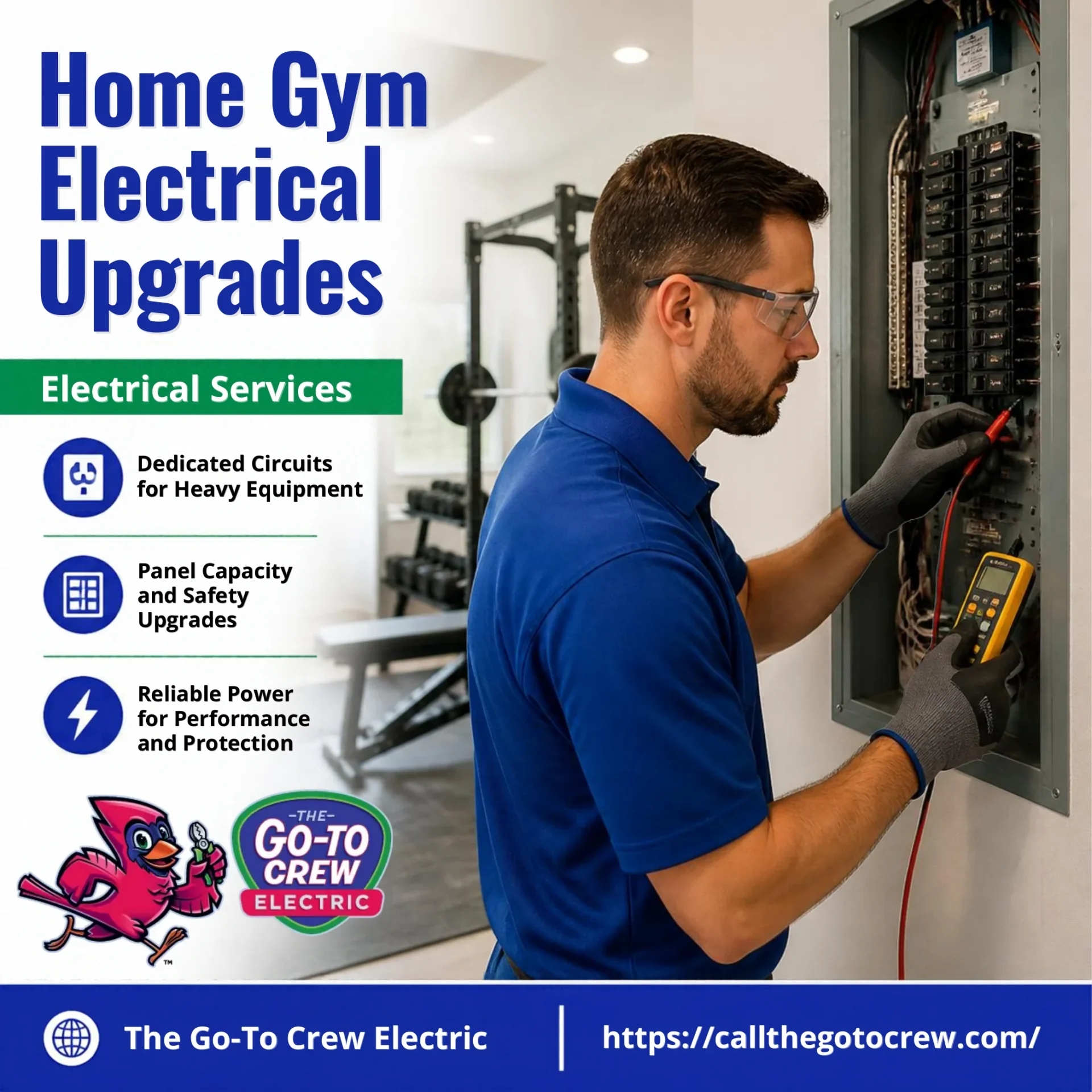
A home gym may need more electrical planning than a typical spare bedroom, especially if you are adding a treadmill, powered exercise equipment, television, smart fitness devices, additional lighting, or a ceiling fan.
The right setup depends on the equipment you plan to use. Some machines draw very little electricity, while certain treadmills and other motor-driven equipment can require much more power. For example, Life Fitness specifies a dedicated 120-volt, 20-amp circuit for several of its treadmill models.
That does not mean every home gym needs a new 20-amp circuit for every machine. The electrical plan should be based on the actual equipment specifications, existing circuit capacity, outlet locations, and how the room may expand over time.
Planning those details before the equipment arrives can help prevent extension-cord clutter, repeated breaker trips, inconvenient outlet locations, and later rewiring.
What Electrical Upgrades Does a Home Gym Need?
A basic home gym with free weights and a stationary bike may need few electrical changes.
A larger fitness space may need upgrades for:
- Treadmills
- Ellipticals
- Exercise bikes
- Rowers
- Smart fitness equipment
- Televisions and sound systems
- Additional receptacles
- Dedicated equipment circuits
- LED lighting
- Ceiling fans
- HVAC or ventilation equipment
- Device charging
- Surge protection
The first step is to make a realistic equipment plan.
Determine where major machines will sit and obtain their electrical specifications before deciding where outlets or new circuits should go.
An electrician can then evaluate:
- Existing branch circuits
- Available circuit capacity
- Outlet locations
- Equipment wattage and amperage
- Panel space and capacity
- Lighting needs
- Fan locations
- Future equipment plans
The Go-To Crew Electric provides customized wiring for renovations and specialized spaces and notes that electrical systems can be planned around both current and future needs.
Learn more about our electrical wiring services.
How Much Power Does Home Gym Equipment Use?
Electrical demand varies dramatically from one piece of fitness equipment to another.
Some equipment needs no electricity at all, including:
- Dumbbells
- Barbells
- Weight benches
- Resistance bands
- Many rowing machines
- Some exercise bikes
Other equipment may need power for motors, resistance systems, displays, fans, consoles, Wi-Fi, speakers, or charging.
A treadmill can be one of the more demanding pieces of home-gym equipment because it uses a motor to move the belt while supporting changing speeds and inclines.
Life Fitness provides a good example of why checking specifications matters. Its Aspire treadmill lists a dedicated 120V/20A circuit in the United States, while the company’s home-gym guidance notes that electrical needs differ among treadmills and other cardio machines.
Do not estimate electrical requirements from the equipment’s size alone.
Before buying powered equipment, check the manufacturer’s:
- Voltage requirement
- Amperage or wattage
- Circuit recommendation
- Grounding requirements
- Instructions regarding extension cords or power strips
Those specifications should guide the electrical plan.
When Does Gym Equipment Need a Dedicated Circuit?
A dedicated circuit serves a specific load rather than sharing capacity with unrelated appliances, lights, or receptacles.
Whether one is needed depends on the equipment manufacturer’s instructions and the existing circuit.
Some higher-demand treadmills specifically require dedicated circuits.
Life Fitness, for example, states that its Aspire treadmill should be installed with a dedicated circuit and dedicated breaker.
A dedicated circuit may deserve consideration when:
- The manufacturer’s instructions require one
- A treadmill repeatedly trips an existing breaker
- Multiple large fitness machines will operate simultaneously
- The existing circuit already supplies other significant loads
- A new gym is being wired during renovation
- The electrical requirements exceed what the existing room circuit can reasonably support
Do not solve repeated breaker trips by replacing the breaker with a larger one.
The wiring, breaker, receptacle, and equipment specifications must all be coordinated.
An electrician can determine whether you actually need a new circuit or whether the existing electrical system already meets the equipment requirements.
Where Should Outlets Be Placed in a Home Gym?
Outlet placement should follow the equipment layout rather than treating the room like an ordinary bedroom.
Think about where you may place:
- Treadmills
- Exercise bikes
- Smart trainers
- Televisions
- Speakers
- Phone chargers
- Fans
- Recovery equipment
- Adjustable desks or workstations
Ideally, powered gym equipment should be able to reach an appropriate wall receptacle without creating cords across walking or exercise areas.
ESFI says that heavy reliance on extension cords often indicates that a room does not have enough permanent receptacles and recommends having additional outlets installed where needed. Extension cords are intended as temporary solutions rather than substitutes for permanent wiring.
Cord placement matters in a gym because the room already contains moving people and equipment.
Avoid designing the room around:
- Extension cords across the floor
- Daisy-chained power strips
- Cords under exercise mats
- Cords pinched behind heavy machines
If you are remodeling the space, decide on equipment locations before walls and flooring are finished.
What Lighting Works Best for a Home Gym?
Good gym lighting should make the room bright enough for safe movement without producing distracting glare.
A practical design may combine:
- General overhead lighting
- Recessed LED fixtures
- Adjustable fixtures
- Task lighting near storage or workout stations
- Accent lighting where desired
LED lighting works well for many home gyms because it can provide substantial light with relatively low electrical demand.
Switching should also be planned around how you enter and use the room.
For example, a larger gym may benefit from separate controls for:
- Main workout lighting
- Accent lighting
- Television or stretching areas
- Ceiling-fan lighting
Consider fixture placement in relation to equipment.
A light directly above a bench, treadmill, or mirrored wall may create glare depending on the fixture and viewing angle.
If you are already opening walls or ceilings to convert a basement, garage, or spare room, it is easier to plan the lighting circuit before finishes are installed.
How Can Ceiling Fans Improve Home Gym Comfort?
A ceiling fan can improve comfort by increasing air movement across the body during exercise.
The U.S. Department of Energy explains that fans create a wind-chill effect that makes people feel cooler; they move air rather than actually reducing the temperature of the room.
That distinction matters in a home gym.
A ceiling fan can supplement the home’s cooling system, but it does not replace adequate heating, air conditioning, or ventilation.
Before installing one, consider:
- Ceiling height
- Equipment height
- Blade clearance
- Exercise movements
- Fan location
- Lighting layout
For example, a fan should not interfere with tall equipment or exercises where hands or weights travel overhead.
The Go-To Crew Electric provides ceiling fan installation, wiring, controls, and smart-fan options intended to improve airflow and comfort.
Learn more about our ceiling fan services.
Does Smart Fitness Equipment Need Surge Protection?
Modern fitness equipment increasingly includes sensitive electronics.
A home gym may contain:
- Touchscreen treadmills
- Connected exercise bikes
- Smart rowing machines
- Televisions
- Speakers
- Wi-Fi equipment
- Computers
- Chargers
- Fitness mirrors
Voltage surges can damage or gradually degrade electronic equipment.
ESFI explains that point-of-use surge protection can protect connected electronics, while whole-home surge protective devices provide broader protection for the home’s electrical system. It also notes that an ordinary power strip is not automatically a surge protector.
There is another important distinction:
A surge protector does not increase circuit capacity.
Plugging several devices into a surge-protective strip does not give the circuit additional electrical power. ESFI notes that power strips provide additional connection points but do not increase the amount of electricity available from the circuit.
So surge protection and load planning solve two different problems.
For expensive connected fitness equipment, homeowners may want to consider both appropriate point-of-use protection and broader whole-home surge protection.
Should a Home Gym Have Additional Ventilation?
Possibly, depending on the room.
Exercise generates heat, and a gym located in a finished basement, garage conversion, or enclosed spare room may feel uncomfortable if the existing heating and cooling system was not designed around the new use.
Electrical planning may need to coordinate with:
- HVAC equipment
- Ductless mini-splits
- Ceiling fans
- Exhaust or ventilation equipment where appropriate
- Controls and thermostats
A ceiling fan can improve perceived comfort through increased air movement, but DOE guidance emphasizes that fans cool people, not the room itself.
If the gym consistently becomes too warm, humid, or uncomfortable, the better solution may involve evaluating the room’s HVAC and ventilation rather than simply installing several portable fans.
Any permanent HVAC or ventilation equipment should be coordinated with its electrical requirements.
An HVAC professional can determine the heating, cooling, or ventilation needs, while an electrician can ensure the selected equipment has the appropriate electrical supply.
How Should You Plan for Future Equipment Upgrades?
Home gyms tend to evolve.
You may start with free weights and later add:
- Treadmill
- Second cardio machine
- Smart fitness system
- Television
- Sauna or recovery equipment
- Additional cooling
- More lighting
Planning only for today’s equipment can lead to inconvenient electrical changes later.
During a remodel, consider:
Extra receptacle locations
It is often easier to install useful receptacle locations before the walls are finished than after equipment has been moved into place.
Possible dedicated circuits
If you already know a treadmill or another high-demand machine is likely to be added later, discuss that possibility with the electrician during the initial wiring plan.
Panel capacity
Several new circuits may require checking both available breaker spaces and overall electrical capacity.
Smart equipment
Connected equipment may need conveniently located power as well as reliable network coverage.
Lighting and fans
If future equipment could change the layout, avoid placing lighting fixtures or fans where they will interfere with tall machines or exercise movements.
The Go-To Crew Electric’s wiring service specifically includes customized electrical layouts and planning around future electrical demand.
A little extra planning during construction can reduce the need to reopen finished walls later.
When Should an Electrician Evaluate the Space?
Professional electrical evaluation makes sense when:
- You are adding a treadmill that calls for a dedicated circuit
- Breakers trip when fitness equipment operates
- The room has very few outlets
- You rely heavily on extension cords
- Multiple powered machines will run simultaneously
- New lighting is being installed
- A ceiling fan is being added
- The gym is part of a basement or garage renovation
- You are adding HVAC equipment
- The panel has limited space
- Existing outlets or wiring appear damaged or outdated
ESFI identifies frequent breaker trips, dimming lights, warm or discolored receptacles, buzzing, and burning odors as warning signs of an overloaded or problematic electrical system that warrants qualified inspection.
The electrician can evaluate:
- Equipment electrical specifications
- Existing circuit loads
- Wiring condition
- Receptacle layout
- Grounding and required circuit protection
- Lighting
- Ceiling fan wiring
- Panel capacity
Virginia currently uses the 2020 National Electrical Code within its effective statewide building-code framework, so new electrical work should also be planned around current applicable requirements.
The Go-To Crew Electric provides electrical wiring, ceiling fan, lighting, panel, outlet, and other residential services throughout Midlothian.
Visit our Midlothian electrician page for local electrical service.
FAQs
Does a treadmill need its own electrical circuit?
Some do.
For example, several current Life Fitness treadmill models specify a dedicated 120V/20A circuit. Other residential treadmills may have different requirements.
Follow the electrical specifications for the exact treadmill rather than assuming every model requires the same circuit.
Can I plug a treadmill into an extension cord?
Check the equipment manufacturer’s instructions before using any extension cord or power strip.
Life Fitness advises against extension cords and power strips for its home-gym equipment, while ESFI recommends that extension cords remain temporary rather than being used in place of permanent wiring.
If the treadmill cannot conveniently reach a suitable outlet, consider having an outlet installed in the correct location.
Can two cardio machines share one circuit?
Possibly, depending on their electrical requirements and the circuit capacity.
Do not make that decision based solely on the number of open receptacles. Check each manufacturer’s specifications and have the existing circuit evaluated if multiple powered machines will operate simultaneously.
Do I need surge protection for a smart treadmill or exercise bike?
Surge protection is worth considering for fitness equipment that contains expensive electronic controls, touchscreens, or networking hardware.
Point-of-use surge protection can protect individual electronics, while whole-home protection provides broader coverage. Remember that a standard power strip is not necessarily a surge protector.
Is a ceiling fan useful in a home gym?
Yes, when the room layout and ceiling height allow it.
A ceiling fan increases air movement and can make people feel cooler while exercising, but it does not actually lower the room temperature.
It should supplement, rather than replace, adequate heating, cooling, or ventilation.
Do I need new wiring to build a home gym?
Not necessarily.
A simple gym may work with the existing electrical system. New wiring becomes more likely when you need dedicated equipment circuits, additional outlets, new lighting, a ceiling fan, HVAC equipment, or other permanent electrical additions.
An electrician can evaluate the room before recommending upgrades.