
A Ground Fault Circuit Interrupter, commonly called a GFCI, is designed to shut off electricity when it detects a potentially dangerous electrical condition. When one trips occasionally, it may simply be doing its job. When a GFCI outlet keeps tripping, however, it can point to moisture, a faulty appliance, a damaged outlet, or a problem somewhere else on the protected circuit.
Repeatedly pressing the reset button without investigating the cause is not a safe long-term solution. The interruption may be inconvenient, but the outlet is responding to a condition that could increase the risk of electrical shock.
Homeowners can perform a few basic checks without removing the outlet or touching any wiring. If the outlet will not reset, trips immediately, feels warm, smells unusual, or continues losing power for no clear reason, a licensed electrician should inspect the circuit.
What Does a GFCI Outlet Do?
A GFCI outlet is a safety device that helps protect people from electric shock. It constantly compares the amount of electrical current flowing from the outlet with the amount returning through the circuit.
Under normal conditions, those amounts should remain nearly equal. If some electricity begins flowing along an unintended path, such as through water, damaged insulation, a faulty appliance, or a person, the GFCI detects the imbalance and quickly disconnects the power.
The Electrical Safety Foundation International explains that GFCIs are designed to cut off electricity when they detect a ground fault or leakage current that could create a shock hazard. They are commonly used in places where electrical equipment may come into contact with water.
GFCI protection is commonly found in areas such as:
- Bathrooms
- Kitchens
- Garages
- Basements
- Laundry rooms
- Crawl spaces
- Outdoor areas
- Locations near sinks, pools, or other water sources
A GFCI receptacle typically has two buttons on its face. The TEST button intentionally trips the device so its protective function can be checked. The RESET button restores power after the cause of a trip has been addressed.
One GFCI receptacle may also protect standard-looking outlets farther along the same circuit. This means an outlet in one room can lose power because a GFCI in another location has tripped.
It is also important to understand that GFCIs and circuit breakers do not serve exactly the same purpose. A traditional circuit breaker primarily protects wiring from excessive current and overheating. A GFCI is specifically designed to respond to current leakage that could shock a person.
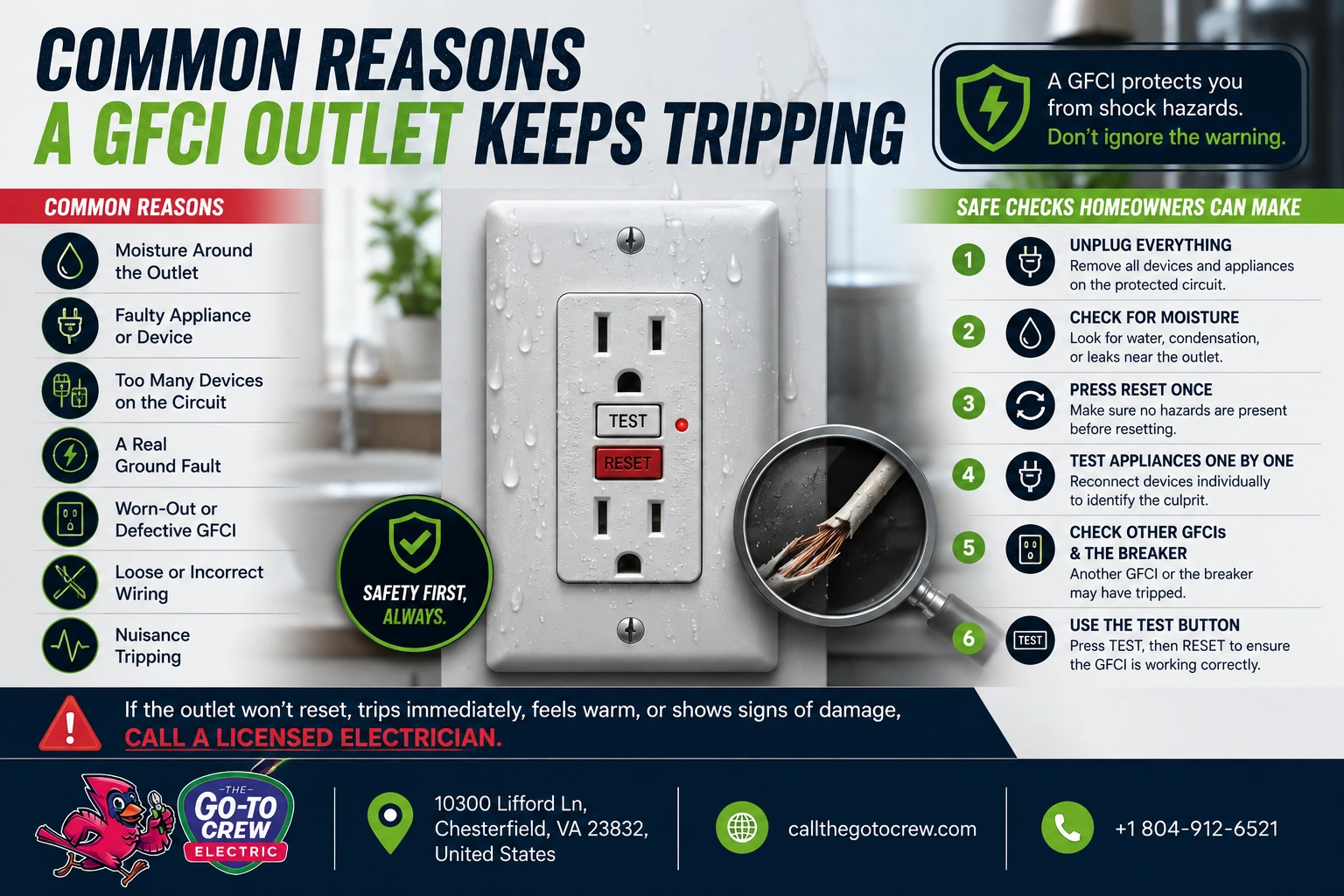
Common Reasons a GFCI Outlet Keeps Tripping
A GFCI may trip for several reasons. Some causes are relatively simple, while others require professional diagnosis.
Moisture Around the Outlet
Moisture is one of the most common reasons a GFCI outlet keeps tripping. Water can create an unintended path for electrical current, causing the device to shut off power.
Moisture may enter an outlet because of:
- Steam or condensation
- A leaking sink or pipe
- Rain entering an outdoor receptacle
- A damaged outdoor cover
- High humidity
- Recent cleaning
- Flooding or standing water
- Water inside an appliance or extension cord
Outdoor outlets may trip after heavy rain, particularly when their covers, seals, or weather-resistant enclosures are damaged. Bathroom and kitchen outlets may also be affected by splashing, leaks, or condensation.
Do not attempt to reset an outlet that is visibly wet. Avoid touching it, disconnect power from a safe location when possible, and have the area evaluated. Electrical devices, breakers, and GFCIs that have been submerged may require replacement rather than drying and reuse. The U.S. Consumer Product Safety Commission has advised that GFCIs exposed to floodwater should be replaced because water damage can compromise their safe operation.
A Faulty Appliance or Device
Sometimes the outlet is not the problem. A connected appliance may have damaged wiring, deteriorated insulation, internal moisture, or another defect that allows electricity to leak from its intended path.
Common devices that may trigger a GFCI include:
- Hair dryers
- Coffee makers
- Toasters
- Refrigerators
- Dishwashers
- Washing machines
- Pressure washers
- Outdoor power tools
- Aquarium equipment
- Extension cords
- Holiday lights
If the GFCI remains set until a particular appliance is plugged in or switched on, that appliance may need to be repaired or replaced. Stop using it until it can be properly evaluated.
A damaged cord or plug may also create a ground fault. Look for cracked insulation, exposed wire, darkened plug blades, melted plastic, or loose connections where the cord enters the appliance.
Too Many Devices on the Circuit
Homeowners often describe any loss of power as an overload, but an overloaded circuit and a ground fault are different conditions. Circuit breakers generally respond to excessive current, while GFCIs respond to current leakage.
However, circuits serving several appliances can experience complex conditions that contribute to tripping. Certain motors, heating elements, or electronic devices may produce small amounts of leakage current. When several devices operate together, the combined leakage may be enough to activate the GFCI.
If power problems occur when multiple high-demand appliances are running, the circuit may also be overloaded. In that case, the breaker may trip in addition to or instead of the GFCI.
Do not use power strips or extension cords as permanent ways to add capacity. An electrician can determine whether appliances should be moved to separate circuits or whether the home needs additional electrical capacity.
A Real Ground Fault
A GFCI trip may indicate that electricity is escaping through an unintended path somewhere in the circuit. This can be caused by damaged insulation, deteriorated wiring, contact between wiring and moisture, or a fault inside an appliance.
Ground faults can be difficult to locate because the problem may not be at the outlet that tripped. A GFCI may protect other outlets, lights, or equipment downstream. Damage anywhere along that protected section can cause the device to shut off.
Possible causes include:
- A nail or screw penetrating a wire
- Rodent-damaged wiring
- Deteriorated insulation
- Water entering a junction box
- Damaged underground or outdoor wiring
- A pinched appliance cord
- A loose electrical connection
- Faulty permanently connected equipment
An actual ground fault should not be ignored. The GFCI may be preventing a dangerous shock.
A Worn-Out or Defective GFCI
GFCI outlets do not necessarily last for the life of a home. Internal components can wear out, become damaged, or fail their self-testing process.
Signs of a deteriorating GFCI may include:
- The outlet will not reset
- The reset button will not stay in
- The outlet trips with nothing connected
- The test button does not work
- The indicator light remains red
- The device feels loose, hot, or damaged
- Power cuts in and out unexpectedly
Modern GFCIs may include reset-lockout technology that prevents the receptacle from resetting when it cannot provide protection. Leviton advises that a GFCI that continues displaying a fault indication or will not reset may need replacement.
Replacement requires access to household wiring and should be completed by a qualified electrician unless the homeowner has the proper training and is legally permitted to perform the work.
Loose or Incorrect Wiring
Loose wiring can create unstable operation, excessive heat, arcing, or intermittent power. A newly installed GFCI may also fail to reset if its incoming and outgoing wires were connected incorrectly.
Because one GFCI may protect several downstream receptacles, a loose connection elsewhere on the circuit can affect multiple locations.
Homeowners should not remove the faceplate or pull the outlet from the electrical box to inspect the wiring. Even when the receptacle appears to have no power, conductors inside the box may still be energized.
Nuisance Tripping
The phrase “nuisance trip” is sometimes used when no obvious danger is visible. Certain appliances with motors, compressors, heating elements, filters, or electronic controls may naturally produce small leakage currents during operation.
However, repeated tripping should not automatically be dismissed as a nuisance. What appears to be an overly sensitive outlet could actually be:
- A deteriorating appliance
- Moisture inside equipment
- Aging electrical insulation
- Improper wiring
- Cumulative leakage from several devices
- A failing GFCI
- A developing ground fault
A qualified electrician can test the circuit and connected equipment to distinguish normal operating characteristics from a genuine hazard.
Safe Checks Homeowners Can Make
Homeowners can take a few limited troubleshooting steps without opening the outlet or performing electrical repairs.
1. Stop and Look for Immediate Hazards
Before touching the outlet, look and smell for warning signs.
Do not reset or use the outlet if you notice:
- Water on or around the receptacle
- Smoke
- Sparks
- A burning smell
- Melted plastic
- Black or brown discoloration
- Buzzing or crackling
- Unusual heat
- A damaged faceplate
- Exposed wiring
Stay away from the area and contact an electrician. If there is smoke, fire, or an immediate danger, leave the home and contact emergency services.
2. Unplug Everything on the Protected Circuit
Unplug appliances and devices from the tripped GFCI. Also check nearby outlets that may be protected by the same device.
This may include countertop appliances, outdoor equipment, garage refrigerators, bathroom devices, extension cords, or anything that lost power at the same time.
Do not unplug a device while standing in water or while your hands are wet.
3. Check for Moisture
Look for visible water, condensation, leaks, or dampness near the outlet and connected devices.
For an outdoor receptacle, inspect the cover from the outside without removing the outlet. A cracked cover, loose lid, or damaged seal may allow rainwater to enter.
Do not use a hair dryer, heat gun, or other electrical device to dry a wet receptacle. Do not insert anything into the slots.
If the outlet has been soaked or submerged, leave it off and arrange for an electrical inspection.
4. Press the Reset Button Once
After all devices have been unplugged and no moisture or damage is visible, press the RESET button firmly one time.
A functioning GFCI may produce a click as it resets. If the button will not stay in, the outlet may still be detecting a fault, may not be receiving power, or may have failed internally.
Do not repeatedly force or hold down the reset button. Reset lockout features may intentionally prevent operation when protection is unavailable.
5. Test Appliances Individually
If the outlet resets and remains on with everything unplugged, reconnect devices one at a time.
Wait briefly after plugging in each item, then operate it normally. If the GFCI trips when one specific device is connected or turned on, unplug that device and stop using it.
Do not keep resetting the outlet to see whether the appliance will eventually work. Repeated tripping associated with one item suggests that the appliance, cord, plug, or connection needs attention.
6. Check Other GFCIs and the Electrical Panel
If the outlet has no power and will not reset, another GFCI on the same circuit may have tripped. Check bathrooms, kitchens, garages, basements, utility areas, and outdoor receptacles.
You may also look at the electrical panel for a tripped breaker. A tripped breaker may sit between the fully ON and OFF positions.
Only reset a breaker when there is no sign of fire, heat, water, or physical damage. Switch it completely OFF and then back ON once. If it trips again, leave it off and call an electrician.
7. Use the Test Button Appropriately
The TEST button is used to verify that the GFCI can interrupt power. Pressing it should trip the device and shut off the protected outlet. The RESET button should then restore power.
Electrical safety guidance recommends testing GFCI protection regularly. If the test or reset functions do not operate correctly, the device may no longer provide reliable protection.
Testing does not diagnose hidden wiring problems, however. A device that repeatedly trips during normal use still needs further investigation.
What Homeowners Should Not Do
Do not:
- Remove the outlet from the wall
- Touch or tighten electrical wiring
- Replace the GFCI without proper training
- Bypass the GFCI protection
- Hold the reset button in place
- Install a standard outlet in its place
- Use an adapter to defeat grounding
- Keep using an appliance that causes trips
- Cover signs of heat or damage
- Assume repeated tripping is harmless
A GFCI is a protective device. Disabling it removes an important layer of shock protection.
When Repeated Tripping Signals a Larger Electrical Problem
A single trip associated with an obvious event, such as water splashing onto an outdoor cord, may be easy to explain. Frequent or unexplained trips are more concerning.
The issue may extend beyond the visible receptacle when:
- The GFCI trips with nothing plugged in
- It trips immediately after resetting
- Several outlets lose power together
- The breaker also trips
- The problem happens during rain
- Lights flicker when the outlet trips
- The outlet is warm or discolored
- The trip occurs when a major appliance starts
- The outlet has recently been replaced
- The problem returns after an appliance is removed
These symptoms may indicate damaged wiring, an incorrectly wired receptacle, moisture inside an electrical box, a downstream fault, a deteriorating circuit, or equipment that requires a dedicated circuit.
Multiple dead outlets can occur because one GFCI protects several receptacles. However, they can also result from a loose connection or open circuit. An electrician can trace the circuit, identify every protected outlet, inspect connections, and perform electrical measurements that homeowners cannot safely complete.
Continued tripping can also be a warning that an appliance is failing internally. Refrigerators, pumps, dishwashers, washing machines, disposals, and outdoor equipment can develop leakage as their motors, heating elements, or insulation age.
The device should not simply be moved to an unprotected outlet. Doing so may allow it to operate while exposing users to a shock hazard.
When Should You Call an Electrician?
Schedule a professional electrical inspection when:
- The GFCI will not reset
- It trips immediately after being reset
- It keeps tripping with all devices unplugged
- One or more outlets remain without power
- Multiple GFCIs are tripping
- A breaker and GFCI trip together
- The outlet feels hot
- The receptacle is cracked or discolored
- You hear buzzing or crackling
- You smell burning plastic or insulation
- Water has entered the outlet
- The problem occurs repeatedly during wet weather
- An appliance consistently causes a trip
- The outlet’s test function does not work
- The outlet was recently installed or replaced
- The wiring in the home is old or has been modified
Manufacturers advise contacting a licensed electrician when a GFCI continues to trip because repeated activation can indicate an electrical hazard.
An electrician may inspect the receptacle, test for leakage current, verify line and load connections, examine downstream outlets, check insulation resistance, evaluate appliances, and determine whether the circuit is overloaded or damaged.
The purpose of the inspection is not merely to make the outlet stop tripping. It is to identify why it is tripping and correct the underlying condition without removing necessary protection.
FAQs
Why does my GFCI outlet keep tripping with nothing plugged in?
The fault may be located somewhere else on the protected circuit. Moisture, damaged downstream wiring, a hardwired appliance, a loose connection, or a defective GFCI can cause the outlet to trip even when its own receptacle is empty.
Why will my GFCI not reset?
A GFCI may not reset if it is not receiving power, is still detecting a ground fault, has reached the end of its useful life, or has an internal reset-lockout feature engaged. Incorrect wiring can also cause a newly installed device to refuse to reset.
Can moisture cause a GFCI to trip?
Yes. Rain, leaks, condensation, damp extension cords, and water inside appliances can create current leakage. Do not reset a visibly wet outlet. Have water-damaged electrical equipment inspected before using it again.
Can one GFCI control several outlets?
Yes. A single GFCI receptacle can protect outlets connected downstream. When it trips, several standard-looking outlets may lose power. The controlling GFCI may be in another bathroom, the garage, the basement, the kitchen, or outside.
Does a GFCI trip because of an overloaded circuit?
GFCIs are primarily designed to detect ground faults, while circuit breakers protect against excessive current. However, appliances on heavily used circuits may have leakage or other electrical problems that contribute to GFCI trips. A professional can determine whether the concern is leakage, overloading, or both.
Is it safe to keep resetting a GFCI?
Resetting it once after unplugging devices and checking for obvious moisture may be reasonable. Repeatedly resetting a device that continues to trip is not safe. The trip indicates that the GFCI is detecting a fault or is no longer operating correctly.
How can I tell whether an appliance is causing the problem?
Unplug all connected devices, reset the GFCI once, and reconnect appliances individually. If the GFCI trips when a particular appliance is plugged in or turned on, stop using that appliance until it has been evaluated.
Can I replace a GFCI with a regular outlet?
A standard outlet should not be used to bypass required GFCI protection. Doing so could expose people to electrical shock, especially in wet or damp locations. A qualified electrician should determine why the GFCI is tripping and install the correct type of receptacle.
Why does my outdoor GFCI trip when it rains?
Rain may be entering the receptacle, an outdoor box, an extension cord, a light fixture, or connected equipment. Damaged weather covers and seals are common contributors. Leave the affected equipment unplugged and have the outdoor circuit inspected.
How often should a GFCI be tested?
GFCI devices should be tested according to the manufacturer’s instructions. Electrical safety organizations commonly recommend regular testing using the TEST and RESET buttons. If either button does not work correctly, the receptacle should be inspected and may need replacement.
Do Not Ignore a GFCI That Keeps Tripping
A GFCI outlet that keeps tripping is not simply a frustrating outlet. It is a safety device responding to current leakage, moisture, faulty equipment, damaged wiring, or an internal failure.
Homeowners can safely unplug connected devices, look for visible moisture, reset the receptacle once, and test appliances individually. Troubleshooting should stop before the outlet is opened or any wiring is touched.
When the outlet will not reset, trips immediately, affects multiple receptacles, or shows signs of heat, damage, or moisture, professional evaluation is the safest next step. A licensed electrician can determine whether the problem is limited to the receptacle or points to a larger issue within the electrical circuit.