A generator breaker usually trips because the electrical demand is too high or the breaker is responding to an electrical fault or abnormal condition.
Generator manufacturers design circuit breakers to protect the generator and connected electrical system from excessive current. Generac explains that its main line circuit breaker interrupts electrical current when too much load is placed on the generator.
One of the most common causes is simply trying to power more equipment than the generator can handle. But repeated breaker trips can also be related to appliance startup loads, wiring problems, a faulty appliance, breaker problems, or issues involving the transfer equipment.
The important point is that a breaker that repeatedly trips should not simply be reset over and over.
Why Does My Generator Keep Tripping the Breaker?
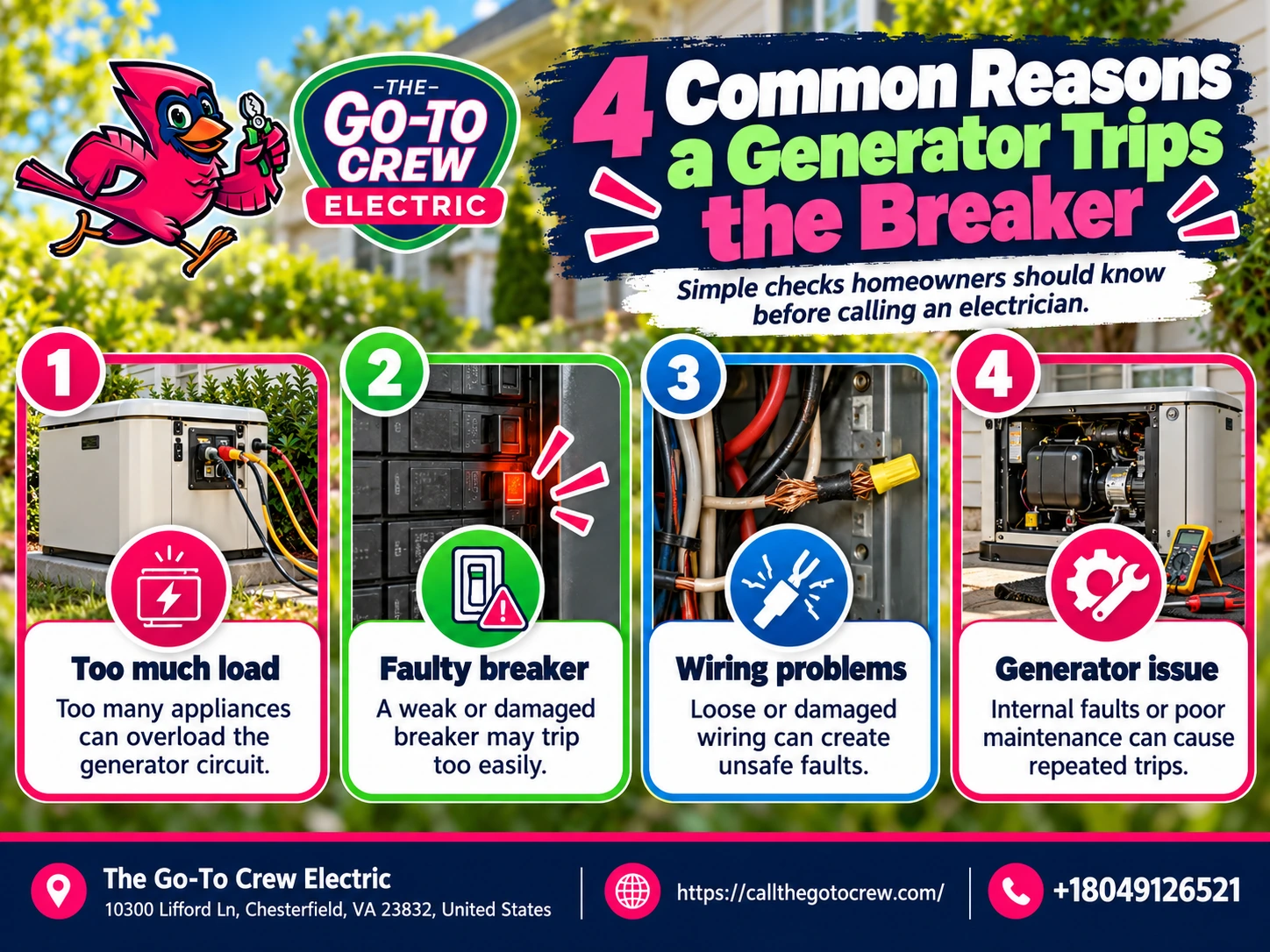
Common reasons include:
- Too much total electrical load
- Several large appliances operating simultaneously
- A motor or compressor drawing high startup current
- A short circuit or electrical fault
- Damaged wiring or connections
- A faulty appliance
- A problem with the breaker itself
- Transfer equipment or load-management problems
Cummins generator guidance states that when a generator-set breaker trips, either too many electrical loads may be connected or a short circuit may be present. It also advises professional evaluation when a breaker immediately trips again after loads have been removed.
The timing of the trip can provide an important clue.
For example:
Breaker trips after several appliances are turned on:
An overall generator overload is more likely.
Breaker trips when an air conditioner, well pump, or refrigerator starts:
Startup demand may be exceeding the generator’s available surge capacity.
Breaker trips immediately even with little connected load:
A wiring fault, damaged appliance, breaker issue, or another electrical problem may need investigation.
Breaker begins tripping after previously working normally:
Something may have changed in the connected equipment or electrical system.
How Does a Generator Breaker Protect the System?
A circuit breaker is a protective device.
Its purpose is to interrupt electrical current when conditions exceed what the circuit or generator is designed to handle.
ESFI explains that standard circuit breakers trip when electrical current exceeds the level allowed by the breaker’s rating. Frequent trips indicate a problem that should be inspected rather than ignored.
On a generator, that protection can help prevent excessive current from damaging:
- Generator components
- Wiring
- Transfer equipment
- Connected appliances
- Other electrical equipment
Generac’s generator main line circuit breaker serves this same basic purpose. If the electrical load becomes excessive, the breaker can trip and stop power from being delivered to the loads.
A tripping breaker is therefore not necessarily a defective breaker.
In many cases, it is doing exactly what it was designed to do.
Can an Overloaded Generator Cause the Breaker to Trip?
Yes. Overloading is one of the clearest reasons a generator breaker may trip.
Every generator has a maximum amount of electrical power it can supply.
If the total demand from the connected equipment exceeds that capacity, the generator’s protective devices may interrupt output.
Generac’s manual transfer-switch guidance specifically states that if the generator main breaker trips after circuits are turned on, the generator has been overloaded and some loads need to remain off.
An overload might occur when trying to run several high-demand loads at the same time, such as:
- Air conditioning
- Electric water heating
- Well pumps
- Sump pumps
- Refrigerators and freezers
- Electric cooking equipment
- Space heaters
- Clothes dryers
- Workshop equipment
The generator’s continuous or running wattage rating is especially important.
A generator may advertise a higher starting or surge rating, but that extra capacity is generally available only briefly.
How Do Appliance Startup Loads Affect a Generator?
Some appliances require considerably more power to start than they need once they are running.
This is particularly common with equipment containing motors or compressors.
Examples include:
- Air conditioners
- Refrigerators
- Freezers
- Well pumps
- Sump pumps
- Furnace blowers
- Air compressors
Champion explains that starting watts are the temporary surge of power needed to start motor-driven equipment, while running watts are the continuous power needed after the equipment is operating.
That difference can be substantial.
For example, Champion’s current generator reference data shows that a 3-ton central air conditioner may require roughly 3,000–3,500 running watts but about 5,000–6,000 watts during startup. A one-horsepower well pump may use roughly 1,000–2,000 watts while running but need approximately 2,000–4,000 starting watts.
Cummins also notes that a generator breaker can trip even when the combined steady-state load appears to be below generator capacity if a large motor or air conditioner starts and temporarily pushes demand above the generator’s rating.
This explains why a generator may seem to handle the house normally until one particular appliance cycles on.
Can Too Many Appliances Trip the Generator Breaker?
Yes.
Even if every individual appliance is operating normally, the combined load may exceed what the generator can safely supply.
For example, a generator might handle:
- A refrigerator
- Lighting
- Internet equipment
- Several small electronics
without difficulty.
But if an air conditioner, well pump, electric water heater, and other large loads operate at the same time, total demand may exceed the generator’s capacity.
This is why generator sizing is not simply about determining whether each appliance can operate individually. You also need to account for which loads may operate simultaneously.
Manual transfer switches can help homeowners manage this by controlling which circuits receive generator power. Generac notes that manual transfer switches can be used to stagger loads and help avoid generator overload.
Standby-generator installations may use other load-management strategies depending on the system.
If normal household operation regularly exceeds generator capacity, an electrician can evaluate whether the problem is:
- Generator sizing
- Load management
- Circuit selection
- Equipment startup demand
- Another electrical issue
Learn more about backup-power systems on our generator services page.
Can Wiring Problems Cause Repeated Breaker Trips?
Yes.
A breaker may also trip because of an electrical fault rather than excessive normal load.
Possible electrical causes can include:
- Short circuits
- Damaged wiring
- Loose connections
- Damaged cords or equipment
- Faulty appliances
- Incorrectly installed equipment
Cummins guidance specifically identifies a short circuit as one possible reason a generator-set breaker may trip.
Electrical faults become especially concerning when breaker trips occur along with:
- Burning smells
- Melted or discolored components
- Buzzing or crackling
- Sparks
- Visible wiring damage
- Heat around electrical connections
The Go-To Crew Electric also identifies repeated breaker trips, burning smells, buzzing, and visible heat damage as electrical problems requiring professional attention.
Do not remove generator covers, transfer-switch covers, or panel dead fronts to look for the fault yourself.
These systems can contain hazardous voltage even when the utility power is unavailable.
Can Transfer Switch Problems Affect Generator Breakers?
They can be part of the troubleshooting picture.
A transfer switch controls which power source utility or generator is connected to the home’s designated electrical loads.
With a portable generator and manual transfer switch, the system can also help homeowners control which circuits are powered so the generator is not overloaded. Generac specifically notes that manual transfer switches allow loads to be staggered while preventing dangerous utility backfeeding.
Standby systems may use automatic transfer equipment and, depending on the installation, load-management controls.
Problems may arise when:
- Loads are not being managed as intended
- Too many circuits transfer onto generator power
- Transfer equipment is malfunctioning
- There is a wiring problem associated with the transfer system
- Generator and transfer equipment were not properly matched or configured
Cummins troubleshooting documentation includes transfer-switch malfunction among conditions that can interfere with correct generator-system operation.
Transfer-switch diagnosis should be left to a qualified electrician or generator technician.
Generac specifically warns against manually operating transfer equipment while energized or with protective covers removed because of electrocution risk.
What Safe Checks Can Homeowners Make?
Homeowner troubleshooting should stay at the user-control and load-management level.
You can safely gather useful information such as:
- Which appliances were operating when the breaker tripped
- Whether one particular appliance consistently triggers the trip
- Whether the generator display shows an overload or fault message
- Whether the generator has previously powered the same loads successfully
- Whether additional equipment has recently been added
- Whether visible cords or plugs show obvious damage
For portable generators, follow the manufacturer’s owner’s manual for overload-reset procedures.
Manufacturer guidance commonly involves turning off or disconnecting loads before resetting the generator’s overload protection and then reconnecting loads gradually. Cummins instructs users to verify that intended running and surge loads remain below generator capacity before reconnecting equipment.
Do not:
- Replace the generator breaker with a larger breaker
- Bypass a breaker
- Modify a transfer switch
- Open energized generator electrical compartments
- Remove panel covers to inspect live wiring
- Backfeed a home through a receptacle
Generac warns that generator backfeeding is dangerous and that proper transfer equipment is designed to prevent utility and generator power from being connected improperly.
When Should You Stop Resetting a Tripping Breaker?
A breaker should not require repeated resets during normal operation.
ESFI advises that frequent breaker trips indicate an electrical problem and should be inspected by a qualified electrician.
Stop repeatedly resetting the breaker when:
- It trips immediately after resetting
- It continues tripping with minimal load
- The same appliance repeatedly triggers it
- You smell burning
- You hear buzzing, sizzling, or crackling
- Electrical components appear discolored or melted
- The generator or connected equipment becomes unusually hot
- The system previously worked correctly and suddenly started tripping
Cummins advises professional assistance if a generator breaker trips immediately again after electrical loads have been disconnected, because a faulty appliance, short circuit, or breaker problem may be present.
Repeated resetting does not fix the reason the breaker is opening.
The goal should be to determine why excessive current or another abnormal condition is occurring.
When Is Professional Generator Diagnosis Needed?
Professional evaluation makes sense when the cause cannot be clearly attributed to exceeding the generator’s documented load capacity or when the breaker continues to trip after normal loads are reduced.
An electrician or generator technician may evaluate:
- Generator output capacity
- Actual connected electrical load
- Appliance starting demand
- Circuit-breaker condition
- Generator wiring
- Connections
- Transfer-switch operation
- Load-management equipment
- Individual branch circuits
- Appliances that repeatedly trigger the problem
The pattern of the trip can help narrow down the problem.
Trips only when several appliances run:
Overall load may be too high.
Trips when one motor starts:
Startup demand or an equipment problem may be involved.
Trips immediately with almost no load:
A fault, wiring problem, or breaker issue deserves investigation.
Trips after transfer to standby power:
The electrician may need to assess the generator load, transfer equipment, and how circuits are being managed.
The Go-To Crew Electric provides generator services as well as circuit-breaker installation, repair, and replacement throughout Chesterfield and surrounding communities.
Learn more about generator services, explore our circuit breaker services, or visit our Chesterfield electrician page for local electrical help.
FAQs
Why does my generator breaker trip when the air conditioner starts?
Air-conditioning compressors can require considerably more power during startup than while running normally.
If the generator is already carrying other loads, that temporary surge may push total demand beyond its available capacity and trip the breaker. Cummins specifically notes that large motors and air conditioners can cause generator breakers to trip during startup even when steady-state loads appear to be within the generator’s rating.
Does a tripped generator breaker mean the breaker is bad?
Not necessarily.
A breaker may be tripping correctly because the generator is overloaded or there is a fault in the electrical system. Breaker failure is one possibility, but the load and wiring should be diagnosed before assuming the breaker needs replacement.
Can I keep resetting my generator breaker?
A single overload event may be reset according to the generator manufacturer’s instructions after the cause has been addressed.
If the breaker repeatedly trips or trips again immediately, stop resetting it and have the problem evaluated. Frequent breaker trips indicate an underlying issue.
Can a refrigerator trip a generator breaker?
It can contribute.
A refrigerator normally uses a relatively modest amount of power once running, but its compressor needs additional starting watts. If the generator is already near capacity, that temporary startup load can be enough to cause an overload.
Can a transfer switch overload a generator?
A transfer switch does not create extra generator capacity.
If the transfer arrangement allows more household load onto the generator than the generator can support or a load-management system is not functioning as intended the generator may become overloaded.
Proper system design should match the connected loads to the generator’s available capacity.
Should I replace a generator breaker with a larger one if it keeps tripping?
No.
The breaker is part of the generator’s protection system and must be correctly matched to the equipment and wiring. Installing a larger breaker to prevent tripping can remove necessary overcurrent protection and create a serious hazard.
Have the reason for the trips diagnosed instead.