
The simplest difference is this:
- GFCI protection is primarily designed to protect people from electrical shock caused by ground faults.
- AFCI protection is designed to reduce the risk of electrical fires caused by dangerous arcing faults.
Although their names sound similar and both may appear as breakers or devices with TEST buttons they monitor different electrical hazards.
The Electrical Safety Foundation International describes GFCIs as protection against potentially severe or fatal shock, while AFCIs detect hazardous arcing conditions that may otherwise start a fire.
Some areas of a home can require both types of protection. In those situations, dual-function AFCI/GFCI devices can provide both protections in one breaker or receptacle.
AFCI vs GFCI Protection: What Is the Difference?
AFCI and GFCI devices both shut off electricity when they detect a dangerous condition, but they are looking for different problems.
GFCI: ground-fault protection
A ground fault happens when electrical current leaves its intended path and begins traveling toward ground.
If a person becomes part of that path, the result can be severe shock or electrocution.
A GFCI monitors the current leaving and returning through a circuit. When it detects even a small imbalance consistent with leakage current, it quickly interrupts power.
AFCI: arc-fault protection
An arc fault involves electricity jumping or arcing through an unintended path.
That can occur because of:
- Damaged insulation
- Loose electrical connections
- Wires damaged by nails or screws
- Damaged cords
- Deteriorated wiring
- Other electrical faults
Arc faults can create enough heat to ignite nearby material.
An AFCI monitors for electrical characteristics associated with hazardous arcing and disconnects the circuit when a dangerous condition is detected.
Neither device makes the other unnecessary. They address different risks.
What Does GFCI Protection Help Prevent?
GFCI protection primarily helps reduce the risk of electrical shock and electrocution.
Ground faults are particularly concerning where electricity and moisture may come together.
For example, a damaged appliance or electrical device can allow current to travel somewhere it was never intended to go. If a person touches the energized equipment while also providing a path toward ground, that current can pass through the body.
A GFCI is designed to detect that imbalance and disconnect power rapidly.
This is why GFCI protection is strongly associated with:
- Bathrooms
- Kitchens
- Garages
- Basements
- Crawl spaces
- Outdoor areas
- Other locations where moisture may be present
ESFI specifically identifies these types of areas as common locations for GFCI protection.
GFCIs are not simply “special outlets for wet rooms.” They are electrical safety devices intended to protect people from dangerous leakage current.
What Does AFCI Protection Help Prevent?
AFCIs are focused on electrical fire prevention.
Arcing can occur when electrical conductors or connections become damaged.
Examples include wiring that has been:
- Pinched
- Cut
- Overheated
- Loosened
- Damaged by fasteners
- Damaged by furniture
- Deteriorated with age
ESFI notes that arc faults can develop from damaged wiring, loose connections, deteriorated insulation, and damaged cords and plugs.
The concern is that an arc may create very high temperatures without necessarily drawing enough current to trip an ordinary breaker immediately.
An AFCI uses electronics designed to recognize potentially dangerous arcing behavior and shut off the affected circuit.
That gives the electrical system another layer of fire protection beyond the traditional overload and short-circuit protection provided by a standard breaker.
Where Is GFCI Protection Commonly Required?
GFCI protection is most commonly associated with areas where electrical equipment is more likely to come into contact with water or grounded surfaces.
Common residential examples include:
- Bathrooms
- Garages
- Outdoor receptacles
- Crawl spaces
- Basements
- Certain kitchen receptacles
- Receptacles near sinks
- Laundry areas and other applicable locations
The exact requirement depends on the electrical code adopted locally, the receptacle or outlet involved, voltage, location, and possible exceptions.
Virginia currently incorporates the 2020 NEC into its statewide building-code framework.
Under the 2020 NEC, dwelling-unit GFCI requirements expanded to cover 125- through 250-volt receptacles in specified locations, along with additional equipment and outlet requirements elsewhere in the code.
Because the rules have expanded over successive code cycles, an older home may not have the same GFCI arrangement you would expect in new construction.
That does not automatically mean every older installation is defective, but renovations, replacements, new circuits, or changed uses can trigger current requirements.
Where Is AFCI Protection Commonly Used?
AFCI protection is commonly used on many 120-volt residential branch circuits serving living areas.
Under the 2020 NEC, AFCI protection applies to many 15- and 20-amp circuits serving areas such as:
- Kitchens
- Family rooms
- Dining rooms
- Living rooms
- Bedrooms
- Dens
- Libraries
- Recreation rooms
- Closets
- Hallways
- Laundry areas
- Similar living spaces
AFCI requirements have expanded significantly over time.
That means an older house may have standard breakers in locations where a newly installed or substantially modified circuit would now require AFCI protection.
The correct protection for an existing renovation or circuit extension depends on the project, existing wiring, and locally adopted code.
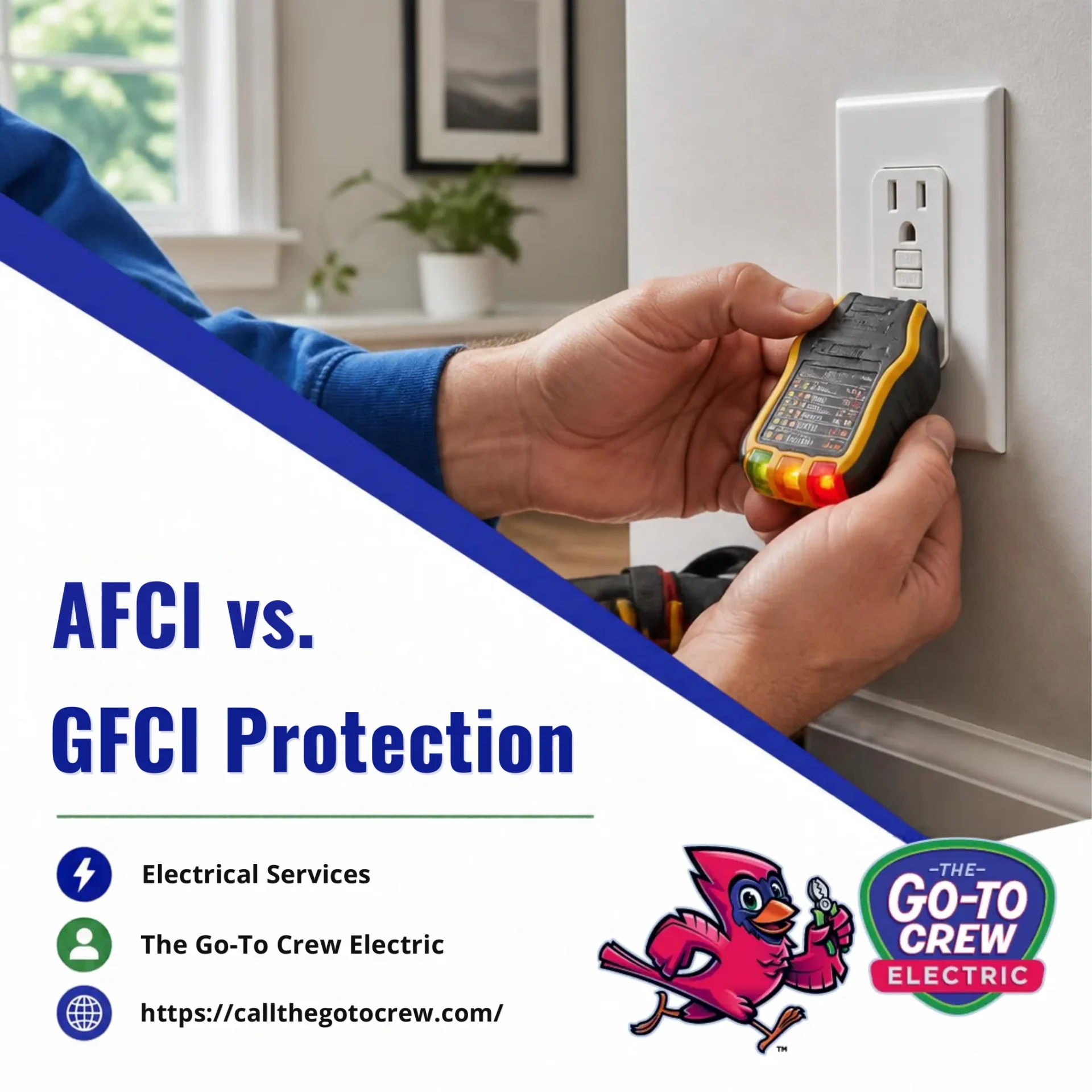
Can One Device Provide Both AFCI and GFCI Protection?
Yes.
A dual-function AFCI/GFCI device can provide both arc-fault protection and ground-fault protection.
These products are available as both:
- Circuit breakers
- Receptacles
Eaton and Leviton both manufacture devices that combine AFCI and GFCI technology so one device can respond to both hazardous arcing and ground faults.
Dual-function protection can be useful in areas where both forms of protection apply.
One terminology point is worth knowing:
A dual-function AFCI/GFCI is not the same thing as a combination-type AFCI.
“Dual function” means the device provides both AFCI and GFCI protection.
“Combination-type AFCI” refers to the AFCI’s ability to detect different types of arc faults; it does not mean the breaker automatically includes GFCI protection.
Are AFCI and GFCI Devices Installed as Breakers or Outlets?
Both types of protection can be provided in more than one form.
GFCI receptacles
These are the familiar outlets with TEST and RESET buttons.
A properly installed GFCI receptacle may also protect additional receptacles downstream on the same circuit.
GFCI breakers
GFCI protection can also be built into a circuit breaker located in the electrical panel.
AFCI breakers
AFCI breakers are commonly installed in the electrical panel and protect applicable branch circuits against dangerous arcing conditions.
AFCI receptacles
Listed outlet branch-circuit AFCI receptacles are also available and can be used in approved configurations.
ESFI notes that AFCI protection may be provided through listed AFCI breakers and certain AFCI receptacle arrangements.
The Go-To Crew Electric’s outlet services include both GFCI and AFCI outlet options, while its circuit-breaker services cover breaker installation, repair, and replacement.
What Causes AFCI or GFCI Protection to Trip?
A trip is not automatically evidence that the protection device itself is bad.
A GFCI may trip because of:
- Current leaking to ground
- Moisture
- A damaged appliance
- Damaged wiring
- Faulty outdoor equipment
- A problem elsewhere on the protected circuit
An AFCI may trip because of:
- A damaged cord
- Loose electrical connections
- Damaged branch wiring
- Deteriorated insulation
- Hazardous series or parallel arcing
- A fault in connected equipment
Repeated trips should be investigated rather than simply reset indefinitely.
It is also important to identify what kind of breaker or device is actually tripping.
A standard breaker, AFCI breaker, GFCI breaker, and dual-function breaker can all interrupt power for different reasons.
Knowing which device opened and what equipment was operating at the time can help an electrician narrow down the cause.
For broader breaker problems, visit our circuit breaker service page.
What Are the Signs a Protection Device Is Not Working Correctly?
AFCI and GFCI devices are supposed to respond when their built-in test function is activated.
ESFI recommends monthly testing and following the manufacturer’s instructions. If an AFCI does not trip when tested, professional replacement is recommended.
Possible warning signs include:
- The TEST button does nothing
- The device will not reset
- Power remains on after the TEST function should have tripped it
- The device repeatedly trips for no identifiable reason
- The receptacle or breaker feels abnormally hot
- You hear buzzing or crackling
- There are burn marks or discoloration
- The device appears physically damaged
A receptacle may sometimes continue supplying electricity even though its protective function has failed, which is why the TEST feature matters.
ESFI recommends monthly GFCI testing as well.
If a protection device fails its test, do not assume that resetting it repeatedly has restored proper protection.
When Should an Electrician Inspect AFCI or GFCI Protection?
Call an electrician when:
- An AFCI or GFCI repeatedly trips
- The device fails its TEST function
- It will not reset
- You see burn marks or melting
- The outlet or breaker is unusually warm
- You hear buzzing or crackling
- A circuit begins tripping after renovations or new appliance installation
- You are unsure whether the correct protection is installed
- Older wiring is being modified
- You are adding circuits or outlets to a home
- The cause of a trip is unclear
Avoid replacing AFCI or GFCI equipment with ordinary devices simply to prevent nuisance trips.
If protection is required, removing it can eliminate an important safety layer without correcting the fault that caused the trip.
ESFI recommends that AFCIs be installed or replaced by a licensed, qualified electrician.
The Go-To Crew Electric provides both circuit-breaker and electrical-outlet services, including GFCI and AFCI outlet options, and serves homeowners throughout Richmond and surrounding areas.
Learn more about circuit breaker services, explore electrical outlet services, or visit our Richmond electrician page.
FAQs
Which is more important, AFCI or GFCI protection?
They serve different purposes, so one does not replace the other.
GFCIs primarily reduce shock risk from ground faults, while AFCIs reduce fire risk from hazardous electrical arcing. Some circuits may need both protections.
Does a GFCI protect against electrical fires?
Its primary purpose is ground-fault shock protection.
A GFCI can interrupt certain abnormal conditions, but it is not a substitute for AFCI protection, which is specifically designed to detect dangerous electrical arcing.
Does an AFCI protect against electric shock?
An AFCI’s primary safety role is arc-fault and fire protection rather than personnel ground-fault protection.
Where shock protection is also required, GFCI or dual-function AFCI/GFCI protection may be used as appropriate.
Can a breaker be both AFCI and GFCI?
Yes.
Dual-function breakers combine AFCI and GFCI protection in one device. Dual-function receptacles are also available.
Why does my AFCI or GFCI keep tripping?
Repeated trips can indicate a real electrical fault, a damaged appliance or cord, moisture, wiring problems, or another condition specific to the type of protective device.
Do not assume that repeated tripping means the device is simply “too sensitive.” Have the cause diagnosed if the trips continue.
How often should AFCI and GFCI devices be tested?
ESFI recommends testing AFCI and GFCI protection monthly and following the manufacturer’s instructions for the specific device.
If the device does not respond correctly to its TEST function, have it professionally evaluated.