
Potentially whether one portable generator can safely power both depends heavily on the generator’s output and the HVAC equipment involved.
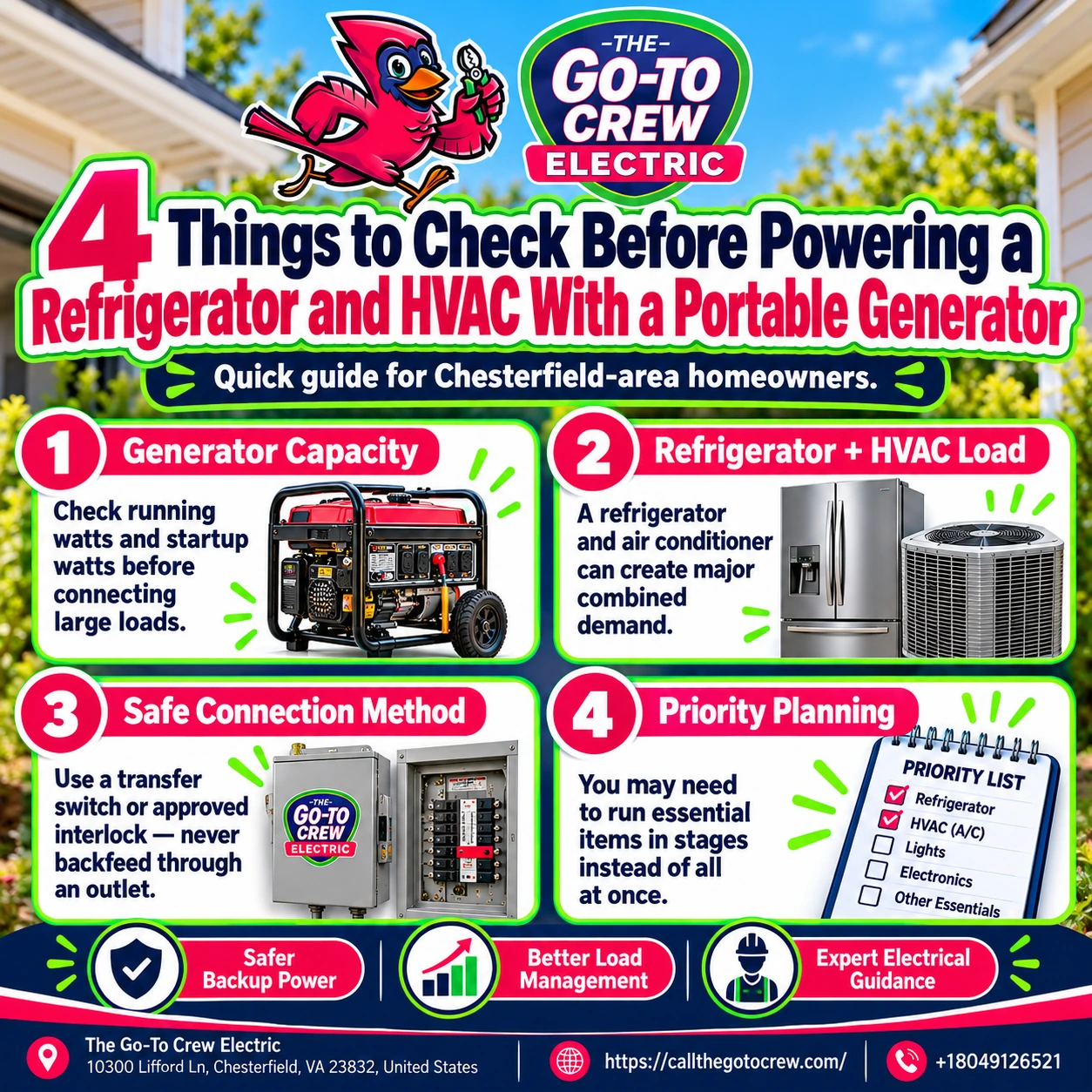
A refrigerator is usually a manageable backup load for many portable generators. Central air conditioning is much more demanding because the compressor can require several thousand watts while running and an even larger burst of power when it starts.
As a reference, Champion’s current generator wattage chart estimates:
- Refrigerator: about 150–400 running watts and 800–1,200 starting watts
- 2-ton central AC: about 2,000–2,500 running watts and 3,500–4,500 starting watts
- 3-ton central AC: about 3,000–3,500 running watts and 5,000–6,000 starting watts
- 4-ton central AC: about 4,000–5,000 running watts and 6,500–8,000 starting watts
These are planning estimates, not substitutes for the actual appliance and HVAC nameplates.
If the HVAC system is hardwired into the home, safely supplying it from a portable generator also requires approved transfer equipment rather than an improvised connection to household wiring.
Can a Portable Generator Power a Refrigerator and HVAC System?
Yes, some portable generators can but many smaller models cannot support both loads comfortably.
The answer depends on four major factors:
- The generator’s continuous or running wattage
- Its temporary starting or surge capacity
- The refrigerator’s startup demand
- The HVAC system’s operating and compressor-starting requirements
A refrigerator may only use a few hundred watts once running, but its compressor requires additional power when it starts.
HVAC equipment can present a much larger challenge.
A central air-conditioning compressor may already require several thousand running watts. When the compressor starts, its temporary demand can rise significantly above that amount.
You also have to account for every other load running at the same time.
A generator that can technically start the HVAC equipment may still become overloaded if it is simultaneously powering:
- Refrigerator
- Freezer
- Well pump
- Sump pump
- Lighting
- Internet equipment
- Furnace blower
- Microwave
- Other household circuits
This is why generator planning should focus on the combined load and the largest simultaneous startup event, not simply whether each appliance can run by itself.
How Is Portable Generator Capacity Measured?
Portable generator capacity is generally described using two wattage ratings.
Running watts
Running watts represent the amount of power the generator can supply continuously during normal operation.
This is the number that matters when determining whether all the appliances you want to keep operating can run at the same time.
Starting watts
Starting watts sometimes called surge watts represent temporary extra capacity available when motors and compressors first start.
That distinction matters because refrigerators, air conditioners, pumps, and similar equipment can require significantly more electricity for a few moments during startup.
For example, a generator might have enough continuous wattage to operate a refrigerator and AC after both are running but still be unable to handle the moment when the AC compressor starts.
Always use the generator manufacturer’s actual ratings rather than assuming its model number equals usable output.
How Much Power Does a Refrigerator Need at Startup?
Refrigerators are usually much less demanding than central HVAC equipment, but they still have a startup surge.
Champion’s current reference chart estimates a typical household refrigerator at approximately:
- 150–400 watts while running
- 800–1,200 watts during startup
Actual demand depends on the specific refrigerator.
Factors can include:
- Refrigerator size
- Compressor design
- Age
- Freezer configuration
- Defrost cycle
- Manufacturer specifications
That startup demand is easy to overlook.
Suppose the refrigerator uses only 250 watts once running. If its compressor briefly needs closer to 1,000 watts to start, the generator needs enough available surge capacity at that moment.
The same principle becomes much more important when an HVAC compressor is also part of the load.
How Much Power Does an HVAC System Require?
There is no universal HVAC wattage.
Electrical demand depends on the equipment type, capacity, compressor, blower, auxiliary heat, and manufacturer specifications.
A small furnace blower may require substantially less generator capacity than a central air-conditioning compressor.
Champion’s reference estimates illustrate how central AC demand can grow with system size:
- 2-ton AC: 2,000–2,500 running watts; 3,500–4,500 starting watts
- 3-ton AC: 3,000–3,500 running watts; 5,000–6,000 starting watts
- 4-ton AC: 4,000–5,000 running watts; 6,500–8,000 starting watts
Those numbers are only examples.
The actual equipment nameplate and manufacturer documentation should be used when planning generator capacity.
Heating can complicate the calculation further.
A gas furnace may primarily need generator power for:
- Blower motor
- Controls
- Ignition equipment
An electric furnace or heat pump with auxiliary resistance heat can require substantially more electrical capacity.
That is why saying a portable generator can “run HVAC” without identifying the equipment is too broad.
Why Startup Wattage Matters for Large Appliances
Startup wattage is often what determines whether a generator that looks large enough on paper actually works with an HVAC system.
Electric motors and compressors can briefly draw much more current as they start than after reaching normal operating speed.
That can create two problems.
First, the generator may trip its overload protection.
Second, voltage can drop excessively if the generator cannot support the startup demand.
The largest startup event often determines the practical generator requirement.
Imagine the generator is already powering:
- Refrigerator
- Several lights
- Internet equipment
- Furnace electronics
Then the AC compressor starts.
The generator has to support the existing running loads plus the HVAC startup surge at that moment.
This is why simply adding the running wattage figures is not enough.
Which Circuits Should You Prioritize During an Outage?
Portable generator planning is often easier when homeowners start with essential loads rather than trying to reproduce normal whole-house electricity use.
Priorities may include:
- Refrigerator
- Freezer
- Medical or accessibility equipment
- Well pump
- Sump pump
- Selected lighting
- Internet or communications equipment
- Furnace controls or blower
- Limited heating or cooling where the generator can support it
High-demand loads may need to remain off depending on generator capacity.
Those can include:
- Electric water heater
- Electric dryer
- Electric range
- Large central air conditioner
- Electric resistance heating
- Hot tub
- EV charger
Load prioritization is especially useful with a manual transfer system because the homeowner can keep nonessential circuits off and avoid exceeding the portable generator’s capacity. Generac notes that manual transfer switches can help users stagger loads and prevent generator overload.
The goal is not to see how many circuits can be turned on.
It is to keep critical equipment operating without exceeding the generator’s limits.
Can a Portable Generator Power Central Air Conditioning?
Sometimes.
A sufficiently large portable generator may be capable of powering certain central AC systems, but several conditions need to line up.
The generator must have:
- Correct output voltage
- Enough continuous wattage
- Enough starting capacity
- Capacity remaining for other essential loads
The HVAC system must also be connected through an appropriate electrical arrangement.
Central air-conditioning equipment is typically hardwired rather than plugged into an ordinary receptacle. If a portable generator is going to supply hardwired household equipment, approved transfer equipment is necessary to isolate generator power from utility power. ESFI states that a transfer switch is the safe method for powering a home’s electrical system from a generator and preventing backfeeding.
An electrician should review the actual HVAC nameplate and generator specifications before assuming the combination is compatible.
For a larger AC system, the HVAC startup requirement alone may approach or exceed the capacity of many common portable generators.
Why Transfer Equipment Matters for Generator Safety
A transfer switch or other approved transfer equipment prevents utility power and generator power from being improperly connected at the same time.
This matters because connecting a portable generator directly into household wiring without proper isolation can cause backfeeding.
Backfeeding can energize utility lines that workers expect to be de-energized and can cause serious injury or death.
ESFI states that generators should never be connected directly to household wiring without an appropriate transfer switch.
Generac similarly describes a manual transfer switch as a way to prevent backfeeding while allowing selected household circuits to run from a portable generator.
Transfer equipment also makes it possible to supply hardwired loads such as certain:
- HVAC equipment
- Well pumps
- Furnaces
- Lighting circuits
Generac’s HomeLink transfer equipment, for example, is specifically designed to allow compatible portable generators to supply selected hardwired circuits.
Installation of this equipment should be handled by a qualified electrician.
Learn more about backup-power options on our generator services page.
What Generator Safety Mistakes Should Homeowners Avoid?
Portable generators introduce both electrical hazards and carbon monoxide hazards.
Never run a portable generator inside
Do not operate a portable generator in:
- A house
- Garage
- Basement
- Shed
- Other enclosed or partially enclosed area
The U.S. Consumer Product Safety Commission recommends operating portable generators outside only, at least 20 feet from the home, with the exhaust directed away from the house and other occupied buildings.
Opening a garage door or window is not enough ventilation.
Never backfeed the house
Do not attempt to power household wiring by improvising a connection through a receptacle.
Generac and ESFI both warn that backfeeding can create lethal electrical hazards for utility workers and others.
Do not overload the generator
Keep the combined running and startup loads within the manufacturer’s ratings.
Repeated overload trips mean the electrical demand needs to be reduced or the backup-power plan needs to be reevaluated.
Keep generators dry
Portable generators should not be operated on wet surfaces or exposed to conditions prohibited by the manufacturer’s instructions.
Use carbon monoxide alarms
ESFI recommends working CO alarms when generators are used for backup power.
A generator should be treated as combustion equipment and an electrical source at the same time.
When Does a Standby Generator Make More Sense?
A standby generator may make more sense when homeowners want backup power to cover larger loads or operate with less manual load management.
Situations where homeowners may want to compare standby and portable options include:
- Frequent or extended outages
- A large central HVAC system
- Well pumps and other hardwired equipment
- Multiple essential household circuits
- Medical or accessibility-related electrical needs
- A desire for automatic backup operation
- Difficulty managing generator setup during severe weather
A permanently installed standby generator can be sized around selected circuits or broader household demand and paired with automatic transfer equipment.
The Go-To Crew Electric’s generator services include generator sizing, installation, transfer equipment, maintenance, and backup-power planning based on the electrical demands of the property.
That does not mean every homeowner needs a standby generator.
A portable unit may be appropriate when the backup goal is limited to a refrigerator, freezer, selected lights, communications, and a few essential loads.
If central HVAC is an important requirement, a professional load assessment can determine whether a portable-generator setup is realistic or whether another backup-power configuration would better match the home’s needs.
The condition and configuration of the home’s electrical equipment may also be part of that planning. Learn more on our electrical panel page.
For homeowners in Chesterfield, The Go-To Crew Electric provides generator and broader residential electrical services for backup-power projects.
Visit our Chesterfield electrician page for local service information.
FAQs
What size portable generator will run a refrigerator and central AC?
There is no single generator size that fits every refrigerator and central AC system.
Champion’s reference figures put a refrigerator at roughly 800–1,200 starting watts, while central AC can range from roughly 3,500–4,500 starting watts for a 2-ton system to 6,500–8,000 watts for a 4-ton unit.
Use the actual appliance and HVAC specifications and include all other loads that will operate at the same time.
Can a 5,000-watt generator run a refrigerator and central air?
It depends on the HVAC system.
A 5,000-watt generator may have enough capacity for some smaller air-conditioning systems and a refrigerator, but it may not have enough starting capacity for a larger central AC compressor once other household loads are included.
Check both running and starting ratings before assuming the system will work.
Can I plug my central AC directly into a portable generator?
Central HVAC is normally hardwired, so it should not be treated like a plug-in appliance.
A portable generator supplying hardwired home circuits requires appropriate transfer equipment that isolates the generator from utility power.
Have a qualified electrician design the connection.
Can I run my refrigerator continuously on a portable generator during an outage?
Potentially, provided the generator has adequate capacity and is operated according to its manufacturer instructions and all generator safety requirements.
Remember that the refrigerator compressor cycles on and off, so its startup demand needs to be included even though its normal running wattage is relatively low.
Why does my generator trip when my air conditioner starts?
The AC compressor may be drawing more starting power than the generator has available at that moment.
This is especially likely when other appliances are already operating. Reduce load and have the generator and HVAC requirements evaluated rather than repeatedly resetting an overloaded system.
Do I need a transfer switch just to run a refrigerator?
If the refrigerator is being supplied as an individual plug-in load according to the generator manufacturer’s approved setup, that is different from energizing the home’s permanent wiring.
If you want the generator to supply panel-connected or hardwired household circuits including central HVAC approved transfer equipment is required to prevent dangerous backfeeding.