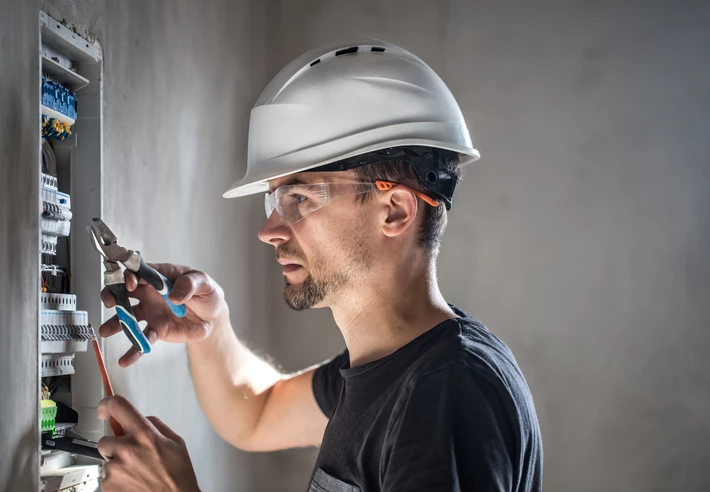
If your breaker trips when the air conditioner starts, the circuit may be responding to unusually high electrical demand or a fault somewhere in the AC equipment or electrical system.
Air conditioners naturally require more electrical current when motors and the compressor first start than they do during normal operation. The circuit should be designed to accommodate that startup demand. If the breaker repeatedly trips as soon as cooling begins, however, possible causes range from a problem with the AC capacitor, compressor, or motor to an aging breaker, loose electrical connection, improper circuit conditions, or another fault.
The important thing is not to keep resetting the breaker and hoping the problem disappears.
At The Go-To Crew Electric, we recommend treating repeated AC breaker trips as a signal that something needs to be evaluated. An electrician can investigate the circuit breaker, electrical circuit, connections, and panel, while an HVAC technician can diagnose problems inside the air-conditioning equipment.
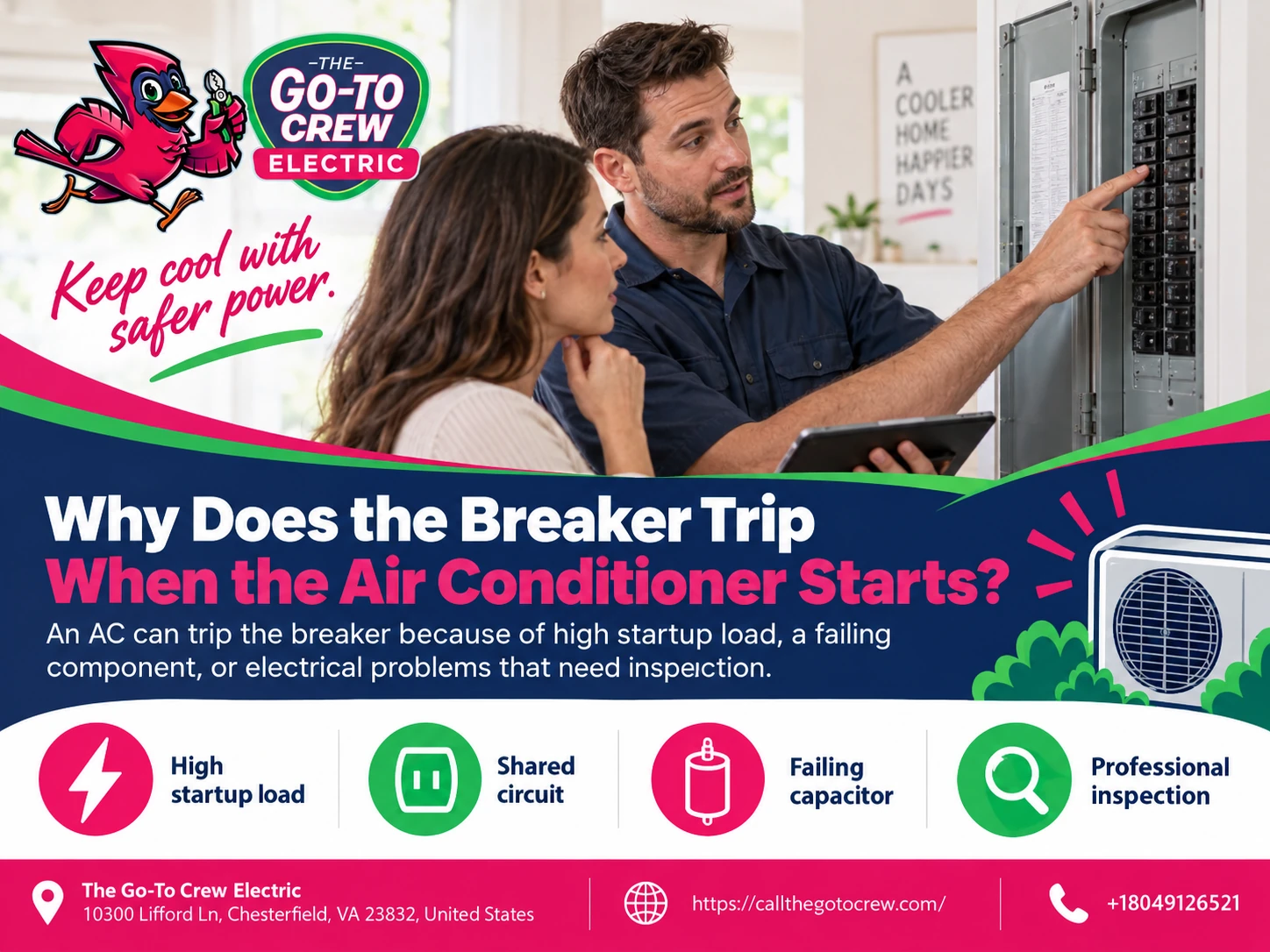
Why Does the Breaker Trip When the Air Conditioner Starts?
A breaker trips when electrical conditions exceed what the protective device is designed to allow or when it detects certain fault conditions.
With an air conditioner, the timing can be revealing.
If the breaker trips right when the outdoor unit attempts to start, the AC may be pulling excessive current during startup.
Possible causes include:
- A struggling compressor
- A failing start or run capacitor
- A malfunctioning fan motor
- A short circuit or other fault
- Damaged equipment wiring
- A loose electrical connection
- A deteriorated or improperly functioning breaker
- Problems with the circuit supplying the equipment
A homeowner generally cannot determine the exact cause from the breaker alone.
One trip is different from repeated trips
A breaker can occasionally trip because of an unusual electrical event.
If it trips again when the AC starts, however, stop treating the reset as the repair.
Repeatedly restoring power can continue exposing damaged equipment or electrical components to the same underlying condition.
If you notice a burning smell, smoke, unusual heat, crackling, visible damage, or significant buzzing around the panel or electrical equipment, leave the affected system off and have it evaluated promptly.
What Happens Electrically When an AC Starts?
An air conditioner does not draw exactly the same amount of electrical current every second that it operates.
Starting is one of its most demanding moments.
Motors need extra power to get moving
The outdoor unit contains equipment such as the compressor and fan motor.
When these components start from a stopped position, they can briefly require substantially more current than they use once they are operating normally.
The electrical circuit and protective equipment are intended to accommodate appropriate startup demand for the connected AC system.
Capacitors help motors start
Many residential AC systems use capacitors to help start and operate motors.
The start capacitor, when used, provides energy that assists the compressor during startup. A failing capacitor can prevent a compressor or motor from starting normally. HVAC manufacturer Trane specifically identifies failed capacitors as one possible reason an AC compressor cannot start properly.
If you hear the outdoor unit humming or trying to start immediately before the breaker trips, that information can be useful to an HVAC technician.
Do not open the outdoor unit or attempt to test or replace a capacitor yourself. Capacitors can retain an electrical charge even when equipment is not operating.
A struggling compressor can increase electrical demand
A compressor that is having difficulty starting may draw abnormal current.
That does not automatically mean the compressor has failed. Capacitor problems, motor conditions, electrical supply problems, and other faults can produce similar symptoms.
An HVAC technician can test the equipment and determine whether the excessive demand originates inside the cooling system.
Is the Problem an Overload or a Short Circuit?
Homeowners often describe every breaker trip as an “overload,” but overloads and electrical faults are not the same thing.
An overload involves too much current
An overload occurs when a circuit carries more current than it is intended to handle for the relevant conditions.
With an AC system, abnormal equipment operation can potentially increase the current draw enough for the breaker to respond.
A circuit or breaker that is not appropriate for the installed equipment can also create problems.
A short circuit is a different type of fault
A short circuit occurs when electricity takes an unintended path with very low resistance, producing a potentially very high current.
Damage to wiring, equipment components, or electrical connections can contribute to fault conditions.
The Go-To Crew Electric’s circuit-breaker guidance identifies protection from both overloads and short circuits as a core function of the breaker.
Timing can provide clues, but not a diagnosis
A breaker that trips immediately when the AC attempts to start may suggest a different problem from one that trips after the system has been operating for some time.
But timing alone cannot tell a homeowner whether the cause is:
- An overload
- A short circuit
- A motor problem
- A compressor problem
- A capacitor problem
- A breaker problem
- A wiring fault
Avoid opening the panel or outdoor AC equipment to investigate.
The safest homeowner contribution is to note when the trip happens and what the AC does immediately beforehand.
Can a Weak Breaker or Loose Connection Cause Tripping?
Yes, problems on the electrical side can sometimes contribute to AC breaker trips.
That is why an HVAC diagnosis is not always the end of the troubleshooting process.
Circuit breakers can develop problems
Circuit breakers are mechanical and electrical devices, and they do not necessarily remain in perfect condition forever.
An electrician can test whether the breaker is functioning appropriately for the circuit and connected equipment.
The solution should never be to replace a tripping breaker with a larger breaker simply to keep the AC running.
Breaker sizing must match the electrical circuit and the requirements of the connected equipment. Increasing breaker capacity without evaluating the wiring and AC specifications can remove important protection rather than solve the underlying issue.
Loose electrical connections can create heat and abnormal conditions
Electrical connections at breakers, disconnects, wiring terminations, and equipment can deteriorate or loosen.
Warning signs can include:
- Unusual heat
- Burning odors
- Discoloration
- Buzzing or crackling
- Intermittent operation
- Visible damage
Do not tighten panel or equipment connections yourself.
An electrician can inspect the supply circuit and electrical connections safely, while an HVAC technician can inspect connections and components within the AC equipment that fall within the HVAC service scope.
A breaker trip should be investigated, not defeated
The breaker is there to protect the circuit.
Bypassing it, installing an oversized breaker, or repeatedly forcing the system back on can increase risk rather than restore normal operation.
Can Electrical Panel Capacity Affect the AC?
Potentially.
An air-conditioning system is a significant electrical load, and the home’s overall electrical system needs to support it appropriately.
The Go-To Crew Electric notes that electrical-panel evaluation includes considering current and future electrical demands.
The AC circuit itself matters
Central air-conditioning equipment is normally supplied through a circuit designed for that equipment.
The correct electrical arrangement depends on factors such as:
- AC manufacturer specifications
- Equipment electrical ratings
- Circuit conductors
- Breaker or fuse protection
- Disconnect equipment
- Existing electrical-system configuration
An electrician can verify that the supply circuit and protective equipment are appropriate for the installed AC.
Overall service capacity may also matter
A panel-capacity problem should not be assumed simply because one AC breaker trips.
However, homeowners adding larger HVAC equipment, major appliances, EV charging, additions, or other substantial loads may benefit from an overall electrical assessment.
A professional electrical panel evaluation can determine whether the existing system has adequate capacity and whether the AC-related issue is isolated to one circuit or part of a larger electrical concern.
Panel age alone does not diagnose the problem
An older panel is not automatically the reason an AC trips a breaker.
Likewise, a newer panel does not rule out a problem.
The condition and configuration of the panel, breaker, circuit, connections, and HVAC equipment all need to be considered.
When Should You Call an Electrician or HVAC Technician?
The most useful question for homeowners is often not simply “What is wrong?”
It is “Who should diagnose it?”
Because an AC combines refrigeration and mechanical equipment with a significant electrical load, the answer can depend on the symptoms.
Call an HVAC technician when the symptoms appear to originate in the AC equipment
An HVAC technician is generally the appropriate first call when you notice symptoms such as:
- The compressor hums but does not start
- The outdoor fan does not start correctly
- The AC attempts to start and immediately shuts down
- The unit has been having cooling problems
- The AC has a known capacitor, compressor, or motor issue
- The equipment is making unusual mechanical sounds
- The system has recently been serviced or replaced and the trip began afterward
Carrier and Trane both identify failed capacitors, compressor or motor problems, and equipment-side wiring faults among possible reasons an AC may fail to start normally.
Call an electrician when the symptoms point toward the electrical supply
An electrician is particularly appropriate when:
- The breaker itself appears damaged
- The electrical panel is unusually hot
- You hear buzzing or crackling at the panel
- There is discoloration around the breaker or panel
- The AC circuit or breaker condition is questionable
- Electrical connections or supply wiring may be involved
- The breaker or circuit needs to be evaluated for the installed equipment
- Other circuits or electrical equipment are also behaving abnormally
- Panel capacity is a concern
The electrician can evaluate the circuit breaker, panel, and electrical supply without requiring the homeowner to open energized equipment.
Sometimes you may need both trades
An HVAC technician may discover that the cooling equipment itself is operating correctly but the electrical supply is not.
An electrician may test the circuit and determine that the supply is appropriate but the AC is drawing excessive current.
In those cases, the two trades solve different sides of the same problem.
What homeowners can safely do
Before calling, gather information without dismantling anything.
Note:
- Whether the breaker trips immediately or after several minutes
- Whether you hear humming or clicking before the trip
- Whether the indoor fan starts
- Whether the outdoor unit attempts to run
- Whether the problem happens every cooling cycle
- Whether you noticed odors, heat, or unusual noises
- Whether the AC or electrical panel was recently replaced or serviced
You can also check the HVAC air filter and thermostat settings as part of ordinary system maintenance.
Do not open the panel, remove AC electrical covers, test live conductors, replace capacitors, change breaker sizes, or repeatedly reset a breaker that continues to trip.
For homeowners in the area, an electrician in Chesterfield, VA can evaluate the electrical side of an AC breaker problem and determine whether the breaker, panel, circuit, or connections require attention.
At The Go-To Crew Electric, our role is to identify problems within the home’s electrical system and help homeowners determine when the issue needs electrical correction rather than HVAC repair.
Do Not Keep Resetting an AC Breaker That Continues to Trip
An air conditioner places one of its largest electrical demands on the circuit when it starts.
The electrical system is designed to accommodate normal startup demand. When the breaker repeatedly trips during that process, something may no longer be operating as intended.
The cause could be within the HVAC equipment, such as a capacitor, motor, or compressor problem. It could also involve the circuit breaker, electrical connections, supply wiring, or panel.
Do not try to solve the problem by installing a larger breaker or repeatedly restoring power.
Instead, pay attention to the symptoms and choose the appropriate professional.
If the AC itself is struggling to start, call an HVAC technician. If the breaker, panel, circuit, wiring, or electrical supply appears to be involved, The Go-To Crew Electric can evaluate the electrical side of the problem.
FAQs
Why does my AC breaker trip immediately when the unit starts?
An immediate trip can result from excessive startup current or an electrical fault involving the AC equipment, compressor, motor, capacitor, wiring, circuit, or breaker. The timing is useful diagnostic information, but homeowners should not try to determine the exact fault by opening the equipment or panel.
Can a bad capacitor make an AC trip the breaker?
A failing capacitor can prevent a compressor or fan motor from starting properly and may contribute to abnormal electrical demand. Capacitors can retain electrical charge, so testing and replacement should be handled by an HVAC professional rather than treated as a DIY repair.
Does a tripping AC breaker mean the breaker is bad?
Not necessarily. The breaker may be responding correctly to excessive current or a fault elsewhere in the system. An electrician can test the breaker and circuit before determining whether the breaker itself needs replacement.
Should I reset my AC breaker if it trips?
If a breaker repeatedly trips, do not continue resetting it. A recurring trip indicates an underlying problem that should be diagnosed. Burning smells, heat, smoke, buzzing, or visible damage are additional reasons to leave the equipment off and seek professional service.
Can an old electrical panel cause the air conditioner breaker to trip?
Panel condition or electrical-supply problems can contribute to AC electrical issues, but age alone does not establish the cause. The breaker, circuit, connections, equipment requirements, and panel should be evaluated together.
Do I need an electrician or an HVAC technician for a tripping AC breaker?
Call an HVAC technician when symptoms point toward the compressor, capacitor, fan motor, or cooling equipment. Call an electrician when the breaker, panel, supply circuit, wiring, or electrical capacity appears to be involved. Some problems require evaluation by both trades before the exact cause becomes clear.